RTX Spark vs GeForce Laptop vs Mac M5 Max: Launch-Week Tests and Reviews
Posted Video released
Right after RTX Spark launched: a 5090 laptop was 2.3-2.4x Spark when the model fits in 24GB, and 100B-class needs 128GB. Third-party reports plus our measurements, as of 10-19.
This post sorts out what to pick between the RTX Spark laptops that had just launched (as of 2026-10-19), GeForce laptops with plenty of RAM, and the Mac M5 Max. We could not measure RTX Spark ourselves. So we took other people's reviews and video measurements, added the numbers we measured and some calculations, and organized them into a way to decide by condition. It is not a post that declares a winner.
The short version: three conditional rules
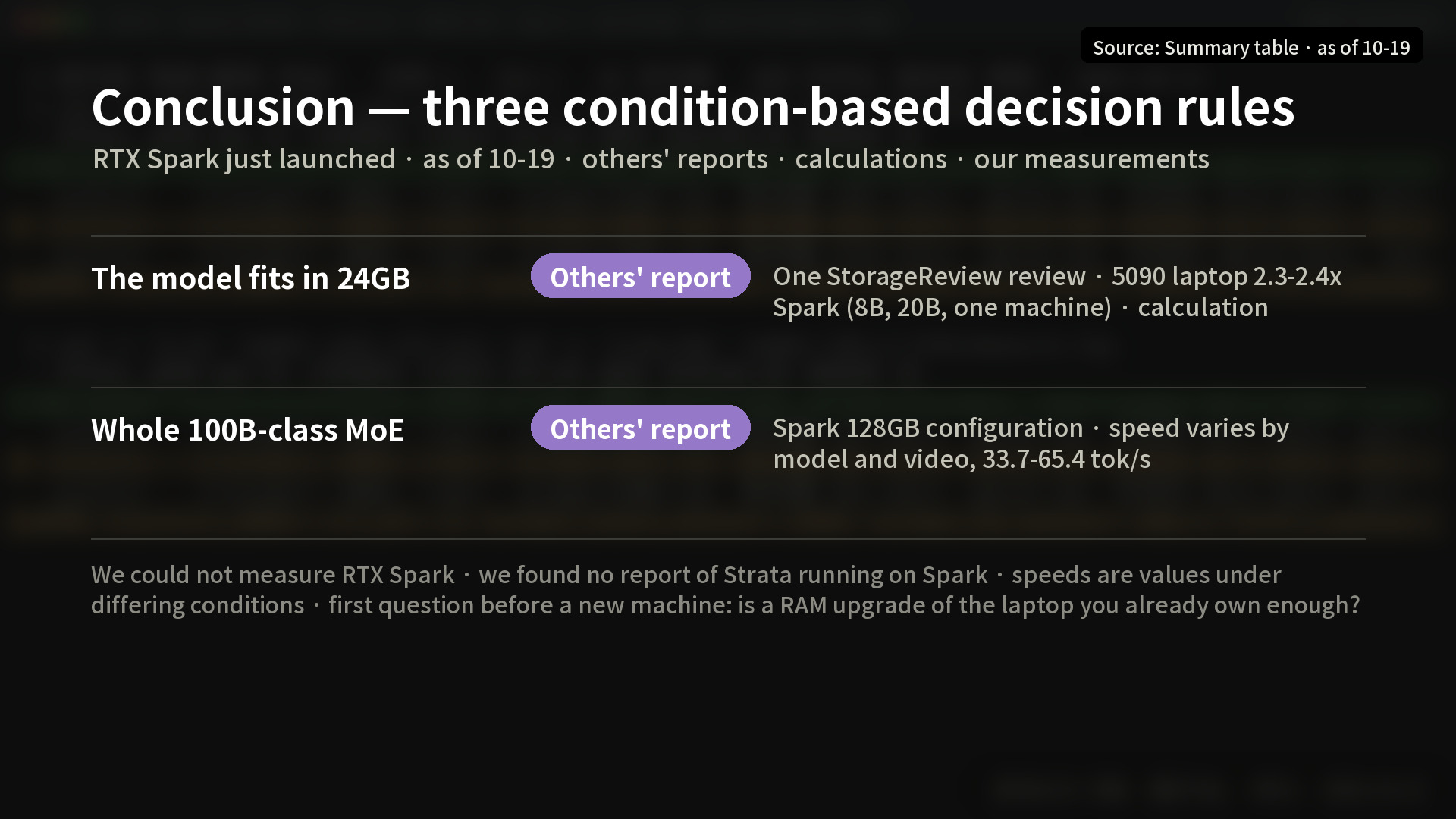
- If the model fits in 24GB, in one StorageReview review the 5090 laptop was 2.3-2.4x the Spark (Llama 8B 128.8 vs 56.5, gpt-oss 20B 137.9 vs 58.0 tok/s, one machine each).
- If you must load a 100B-class MoE whole, a Spark 128GB configuration is an option. Speeds were scattered at 33.7-65.4 tok/s depending on the model and the video.
- Total RAM is not the memory a model can load into. The HP 128GB model set the GPU share to 64GB, and the usable amount was 62.5GB.
We found no report of Strata running on RTX Spark, and we could not check Reddit reactions.
First, the kinds of numbers
- Our measurement: values we measured ourselves on rented servers. CPU, RAM limit and power differ per server, so we do not rank them against each other.
- Review measurement (third-party reports): values measured by others, such as StorageReview, Tom's Hardware, Artificial Analysis and the Alex Ziskind and Matthew Moniz videos. Software and quantization often differ or are not stated.
- Official / documentation: the NVIDIA developer docs and the requirements in the Strata docs.
- Calculation / estimate: things that are not measurements, such as bandwidth divided by model size. These are labeled separately.
RTX Spark is a chip that shares its memory
The NVIDIA developer docs describe RTX Spark as a chip where the CPU and GPU share memory, with up to 128GB LPDDR5, a 256-bit bus and 300GB/s. Whether a model loads is judged by whether the model file size plus the KV cache fits within the memory the GPU can use.
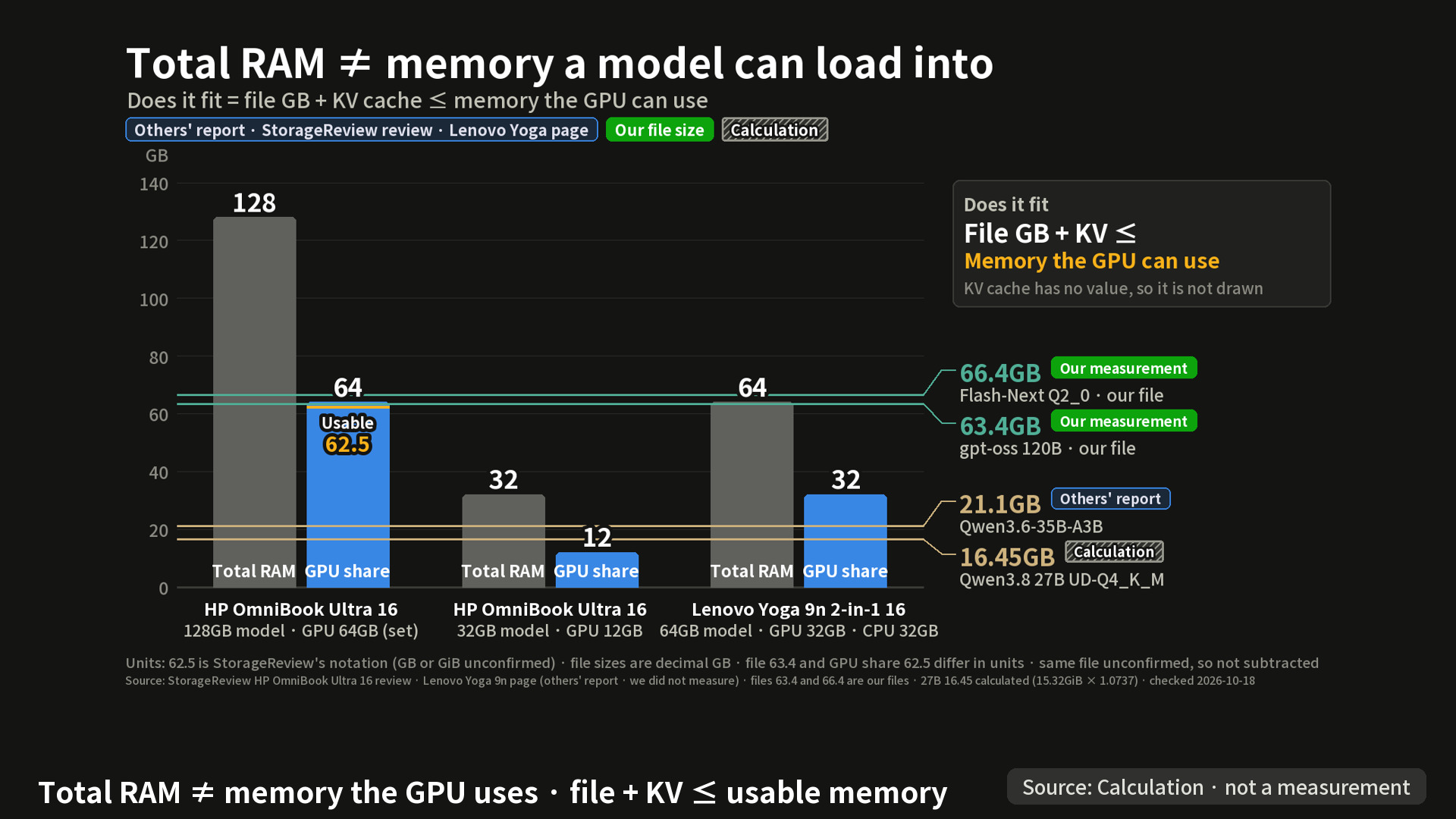
StorageReview's HP had the GPU share set to 64GB on the 128GB model and 12GB on the 32GB model, and the ratio can be adjusted in the NVIDIA app. In the chart, 63.4GB (gpt-oss 120B) and 66.4GB (Flash-Next Q2_0) are the sizes of the files we hold, while 62.5GB is StorageReview's figure, whose unit (GB or GiB) was not confirmed. We could not confirm they refer to the same file, so we did not subtract one from the other to compute headroom.
8B-20B class: when it fits in 24GB, the 5090 laptop was ahead
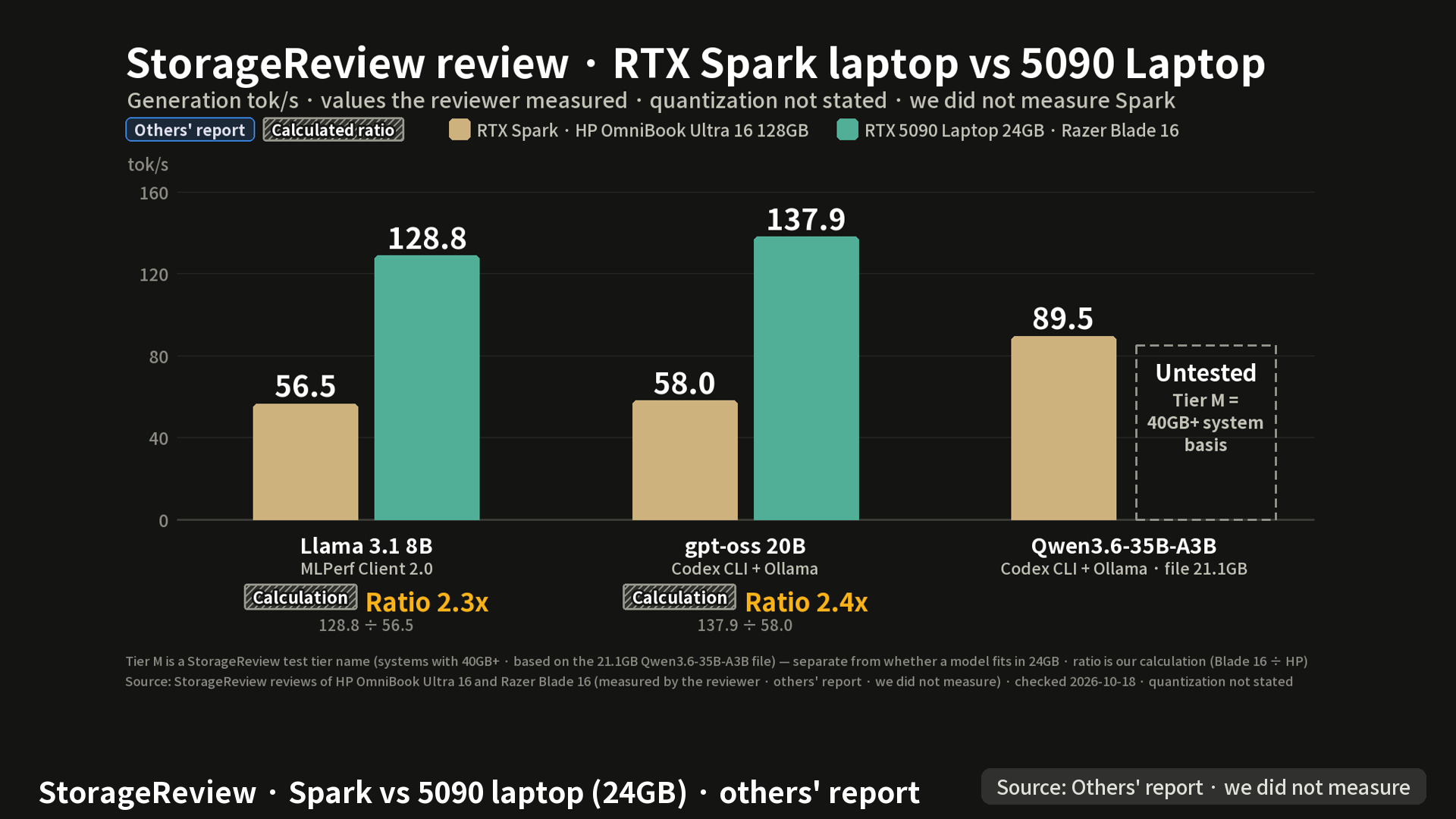
| Model | RTX Spark (HP OmniBook Ultra 16 128GB) | RTX 5090 Laptop 24GB (Razer Blade 16) | Ratio (our calculation) |
|---|---|---|---|
| Llama 3.1 8B (MLPerf Client 2.0) | 56.5 | 128.8 | 2.3x |
| gpt-oss 20B (Codex CLI + Ollama) | 58.0 | 137.9 | 2.4x |
| Qwen3.6-35B-A3B (21.1GB file) | 89.5 | not measured | - |
All are third-party reports measured directly by the StorageReview reviewer, and the quantization is not stated. The review's sentence that things which fit in 24GB run 2.3x faster matches our calculation of 2.3-2.4x. The 35B model was not run on the Blade 16 because StorageReview's test tier (Tier M) is defined for systems with 40GB or more. That is a separate criterion from whether a model fits in 24GB.
27B-35B class: the same 27B ranges from 13.4 to 26.32
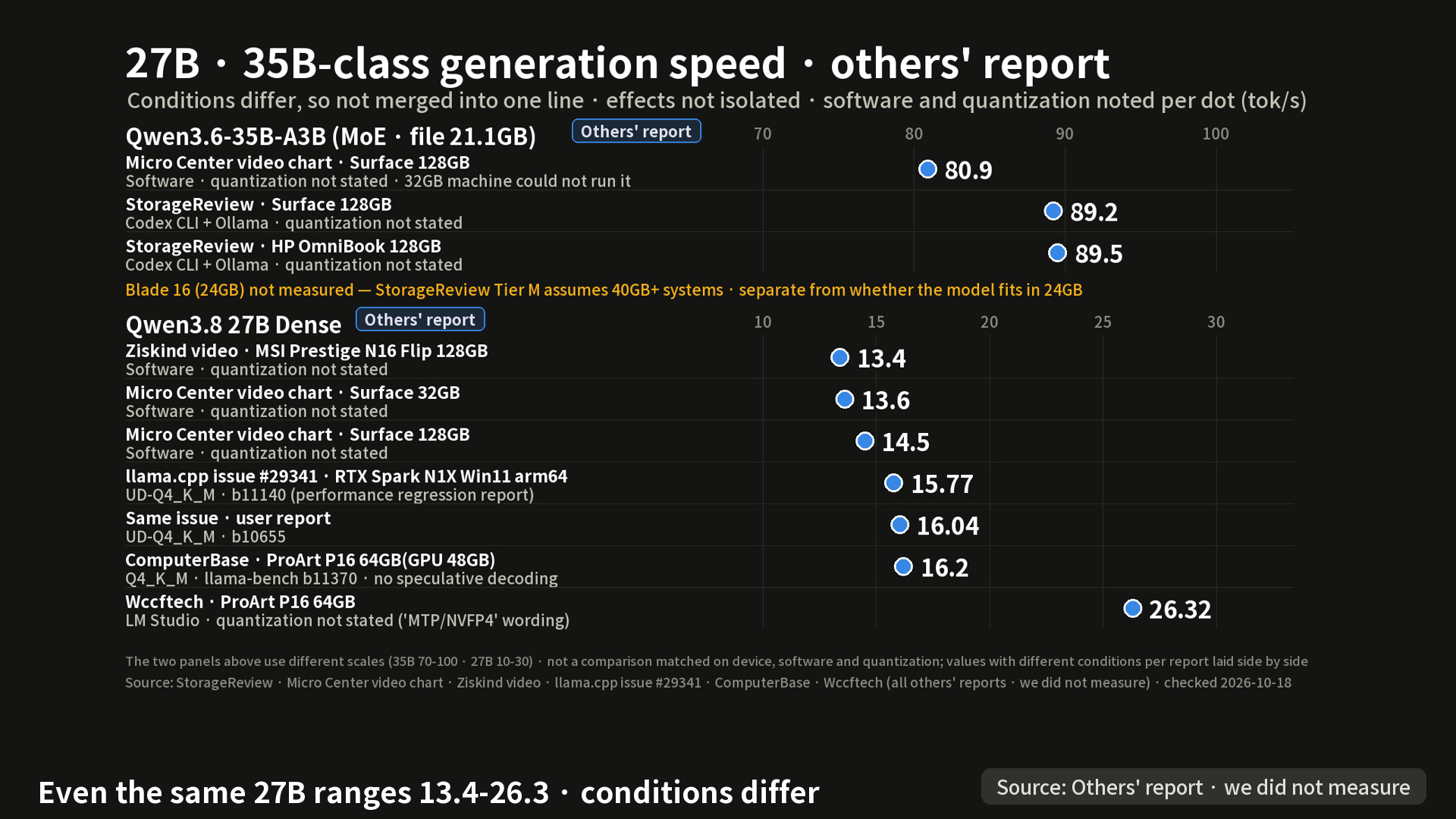
Qwen3.6 35B A3B (MoE) ran at 89.5 tok/s on the HP Spark (StorageReview). The video's chart also shows 80.9 from Micro Center, which noted that the 32GB machine could not run it. For Qwen 27B Dense, Ziskind reported 13.4 and Wccftech (LM Studio) reported 26.32 tok/s, nearly double. The software, quantization and MTP wording differ, so we could not isolate the cause of the gap. This dot plot is not a same-condition comparison; it lays out values whose conditions differ by report.
Reports that compare with the Mac: the direction flips by test
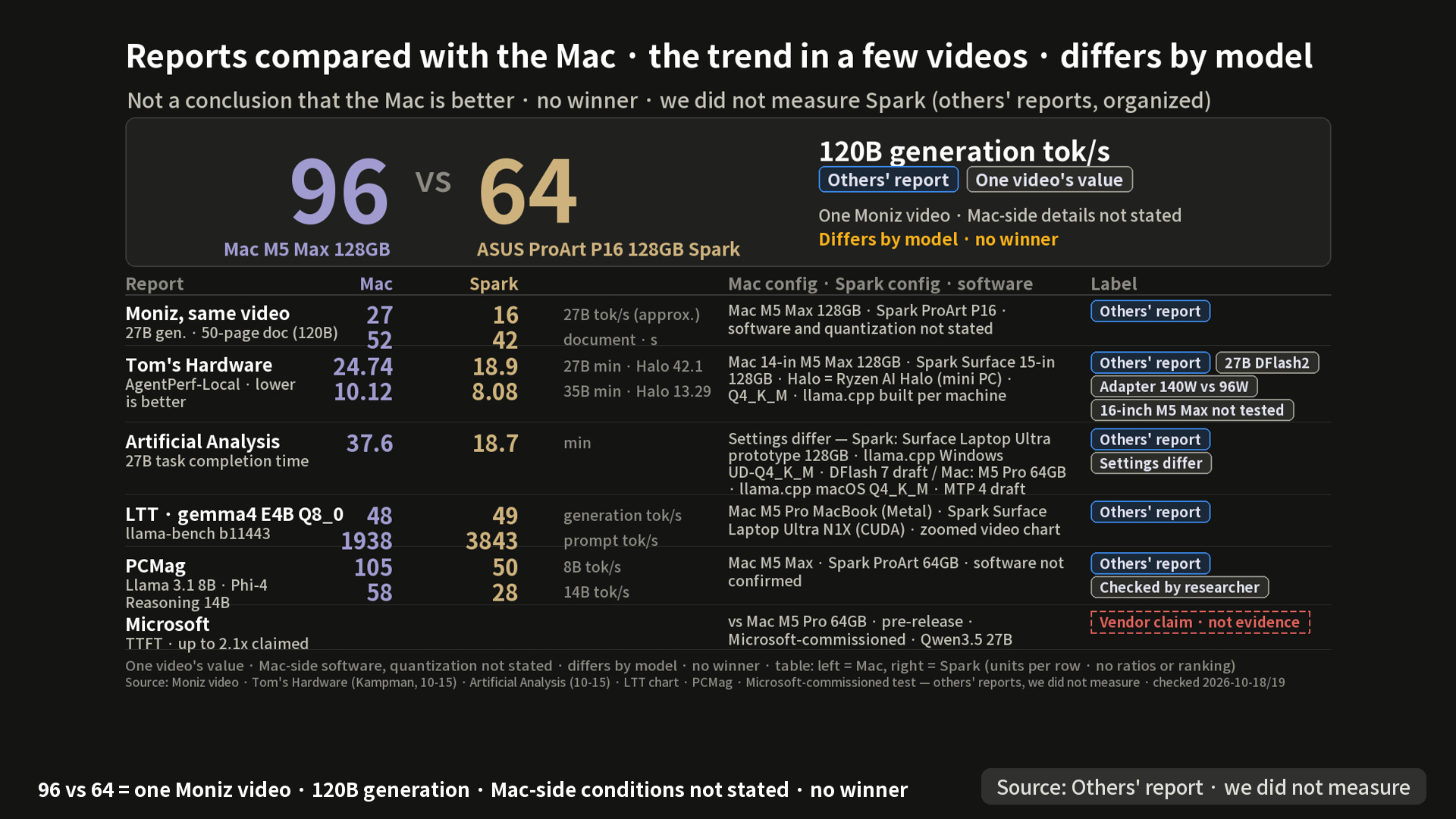
- One Moniz video: for 120B generation, the 128GB M5 Max scored 96 and the ASUS ProArt P16 (128GB Spark) 64, and 27B generation in the same video was 27 vs 16. The video did not mention the Mac-side software or quantization.
- Tom's Hardware 27B agent task (AgentPerf-Local) completion time was 18.9 minutes on the Surface Laptop Ultra 128GB and 24.74 minutes on the MacBook Pro 14-inch M5 Max 128GB (lower is better). The adapters differed, 140W vs 96W, and the 16-inch M5 Max was not tested.
- Artificial Analysis lists 37.6 minutes for the M5 Pro 64GB. The Spark side was set up differently, so this value should not be read next to it.
Because the direction flips by test, this is not a conclusion that either side is better.
100B class and above: 33.7-65.4 on 128GB configurations
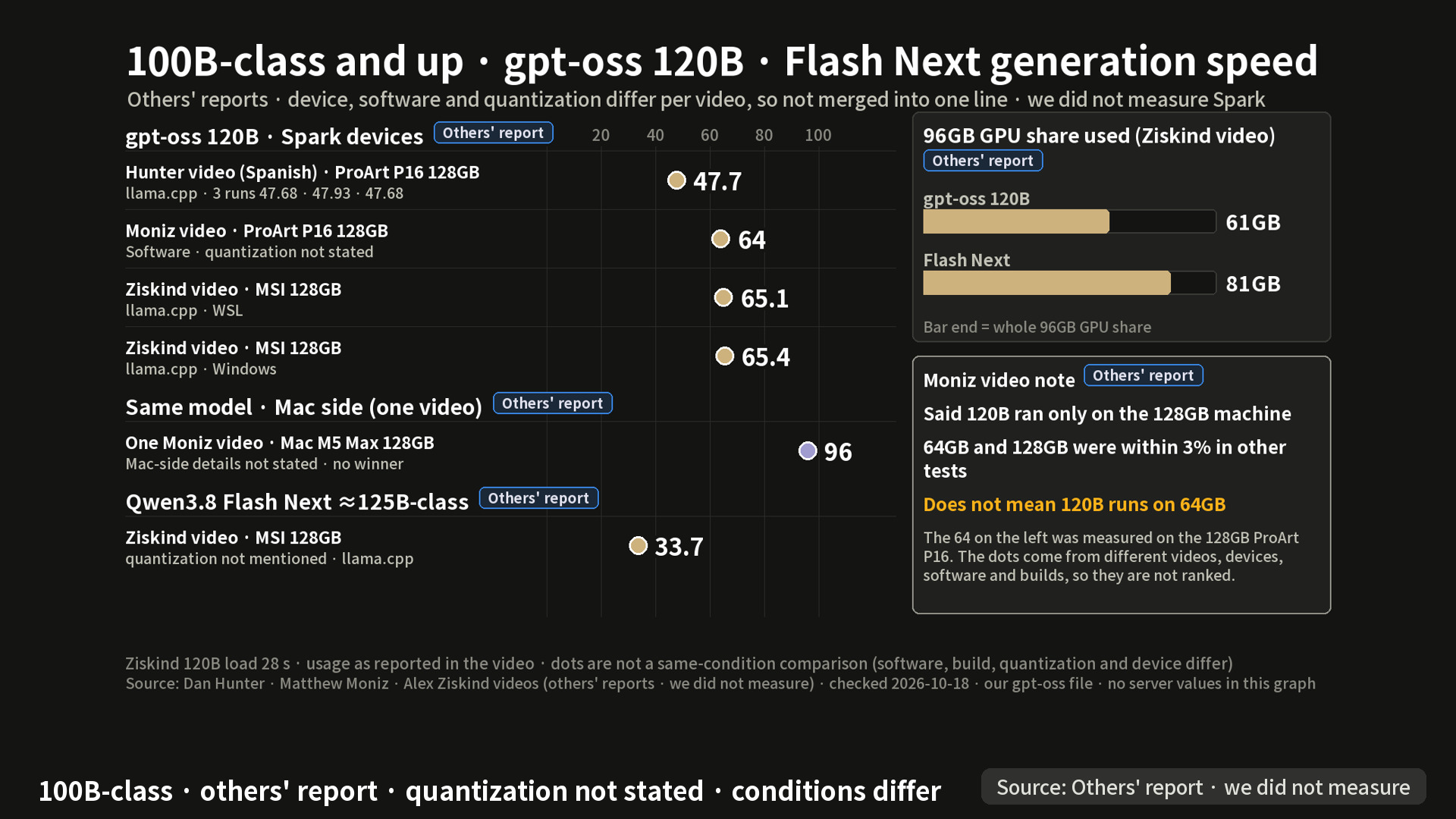
gpt-oss 120B ran at 65.4 tok/s in Ziskind's video and 47.7 in Dan Hunter's. Flash Next (about 125B class) ran at 33.7 tok/s in Ziskind's video, with no quantization mentioned. In Ziskind's video, the 120B used 61GB of a 96GB GPU share. Moniz's video said the 120B ran only on the 128GB machine. The dots come from different videos, machines, software and builds, so we do not rank them.
What we measured: when RAM runs short, reading speed collapsed
We measured Flash Next with Strata on rented servers. Strata is an engine that puts the experts used most on the GPU while RAM and the processor handle the rest of a large MoE model, and it reads from SSD when RAM runs short (per its documentation). The Strata docs require 12GB or more of VRAM and 32GB or more of RAM (with 64GB, every size works).
- RTX 3060 12GB (container RAM limit 42.6GiB): Q2_0 Korean generation 39.5 tok/s (range 37.4-40.1, 10-13)
- RTX 3090 24GB (server A): Q2_0 Korean 112.1, IQ3_S 98.9 tok/s (10-14)
- On the same 3090, when RAM was cut to 32GiB (reproduced with an occupying process, not a machine that really has that RAM), 4,000-token reading speed fell from 2277 to 1664 tok/s for Q2_0 and from 2045 to 207 tok/s for IQ3_S.
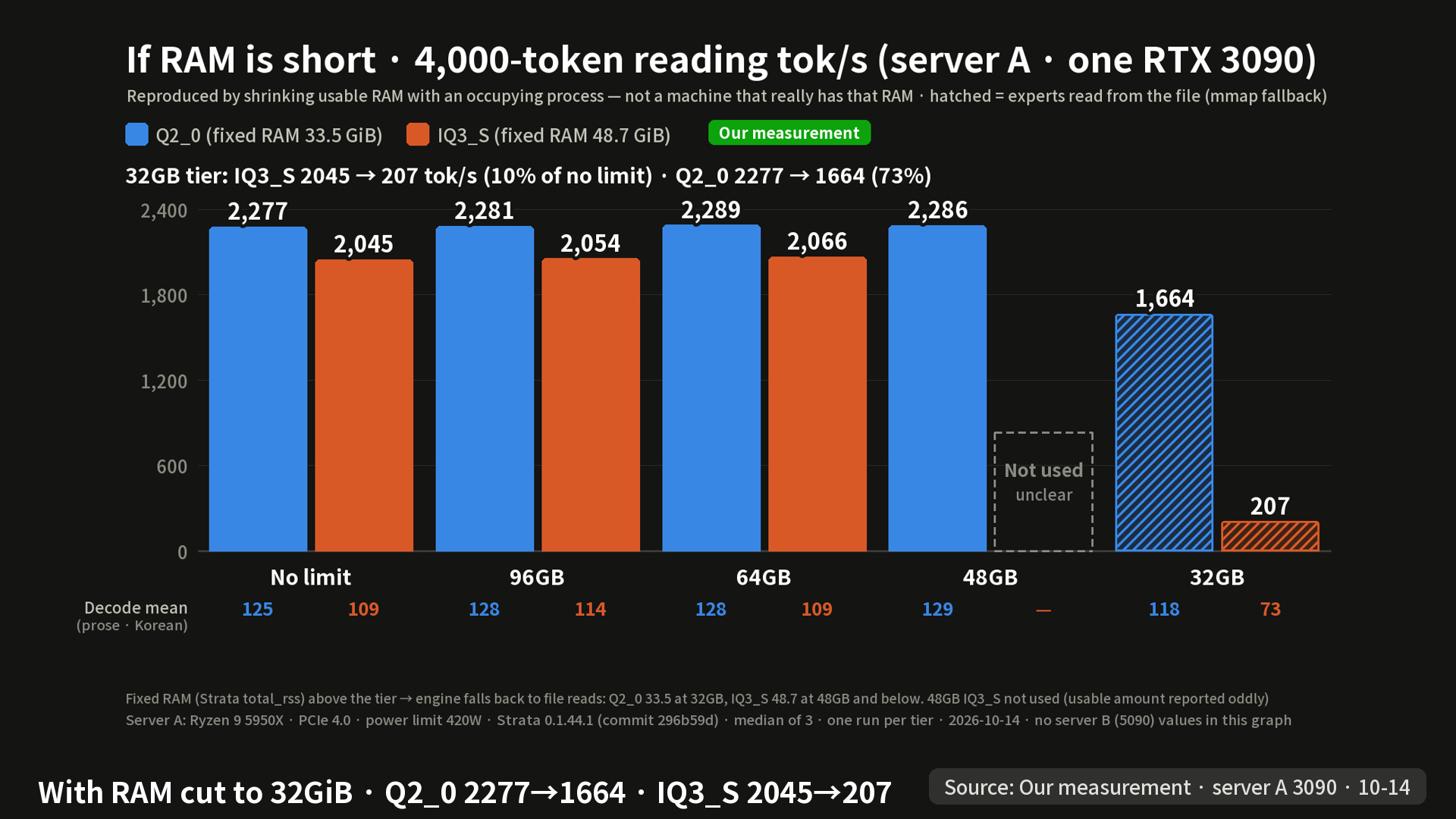
The Mac mini Strata values are on a card in the video, and because the chip differs we did not line them up against Spark. We also did not combine bandwidth figures, because the NVIDIA documentation spec and the CPU-side measurements were taken at different places.
Calculation: the generation ceiling for 27B from bandwidth (not a measurement)
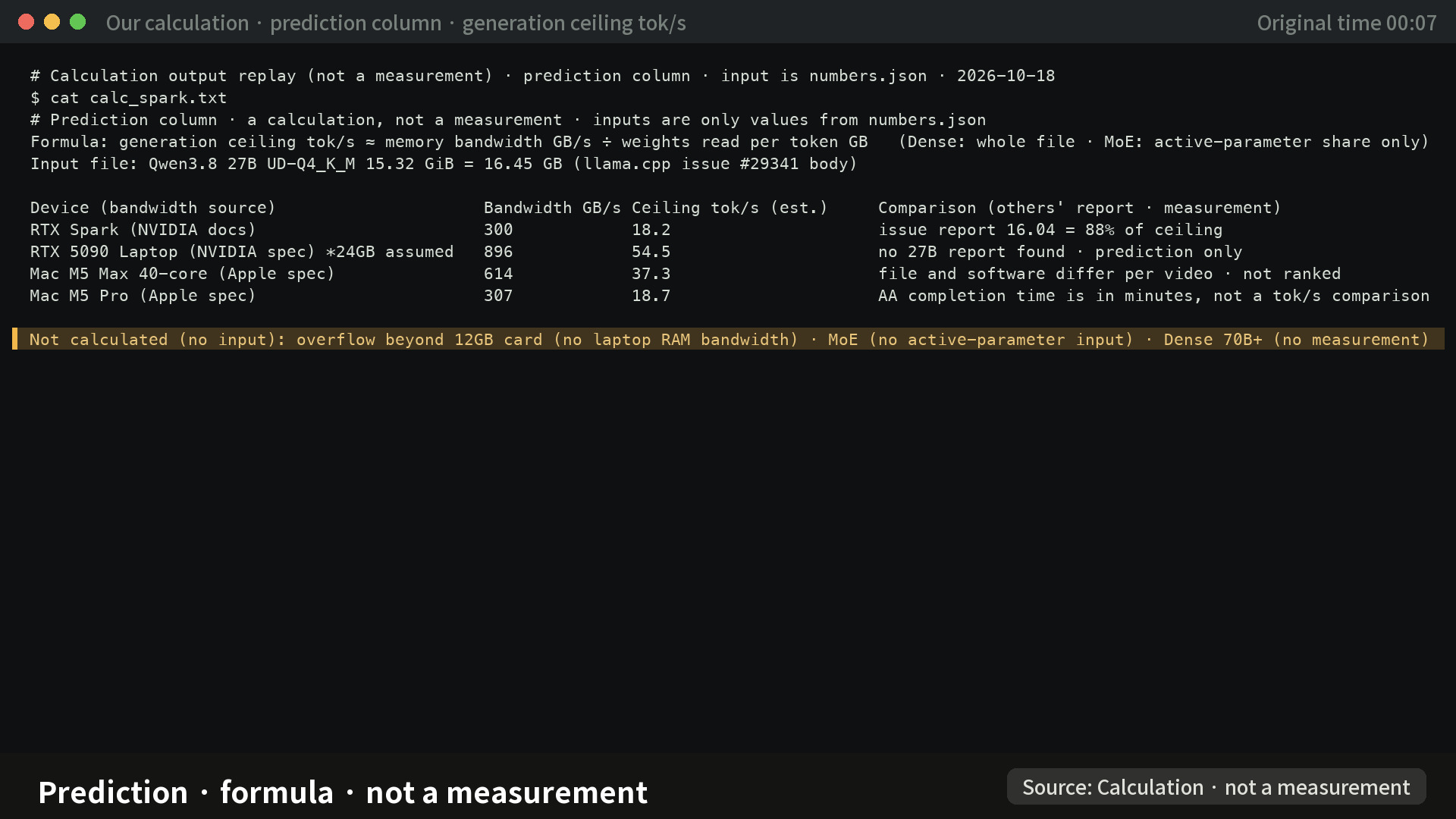
The generation ceiling is bandwidth divided by the weight size read per token. Putting Spark's 300GB/s over the 16.45GB 27B file gives 18.2 tok/s, and the user report of 16.04 in a llama.cpp issue is 88% of that. For the 5090 laptop, assuming the file fits on a 24GB card and using the 896GB/s spec gives 54.5 tok/s, but we found no measured 27B report. It is an estimate only.
Choosing a model: does it fit, then speed, then quality
For speed we use other people's reports, and for quality we use only what we measured. On our KMMLU 150 questions, Qwen 27B scored 98 for UD-Q4_K_XL, 96 for IQ3_XXS and 93 for IQ2_M, which cannot be told apart. Flash Next scored 303 for Q2_0 and 334 for UD-IQ4_XS on 450 questions. We have no quality measurements for the other models.
Before looking at a new machine: can the laptop you already have do it
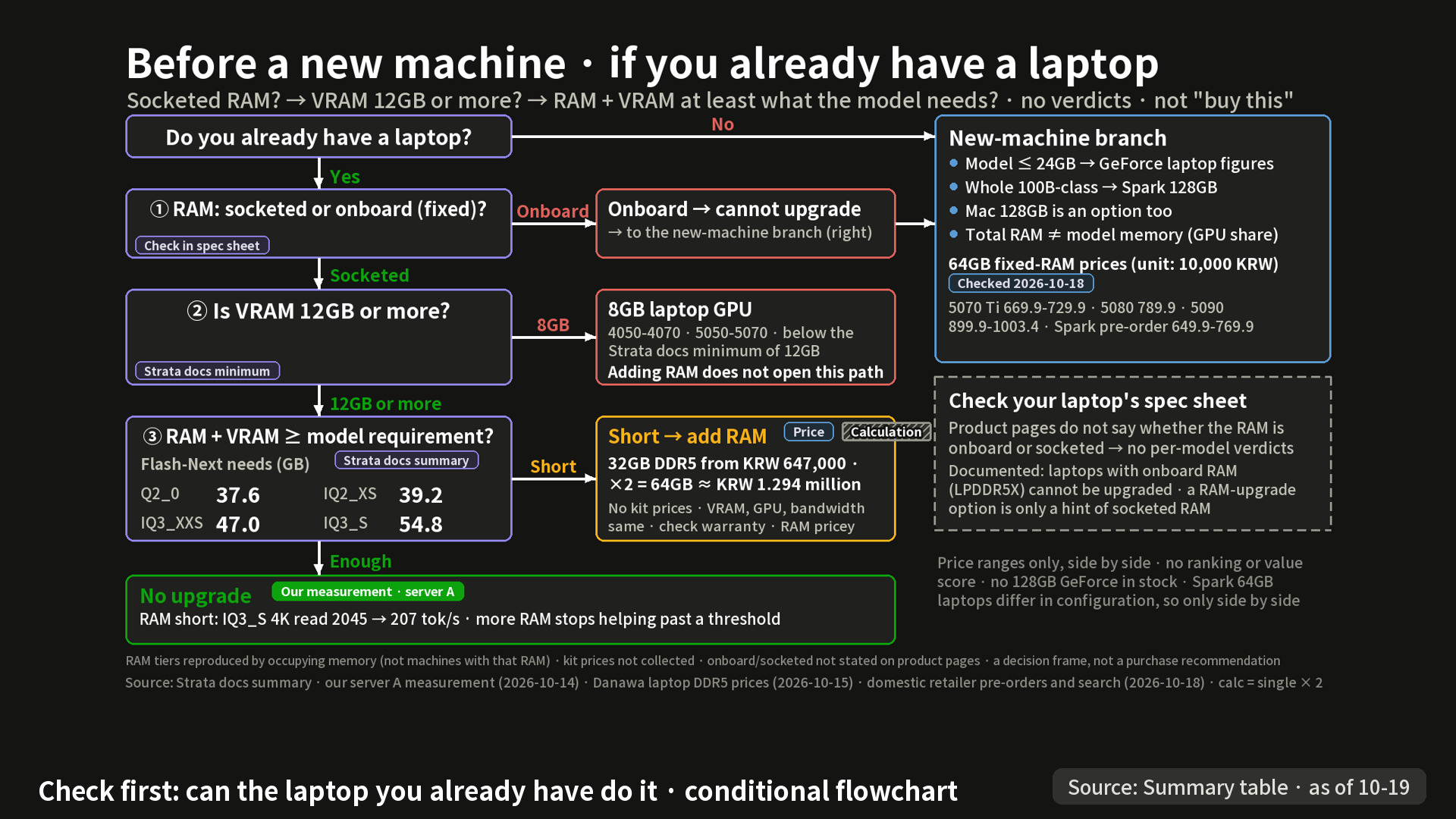
The first question is whether adding RAM to a laptop you already have is enough. If the RAM is onboard rather than socketed, it cannot be increased; next is whether VRAM is 12GB or more. An 8GB-VRAM laptop falls short of the Strata docs' minimum even with more RAM. The combined RAM plus VRAM needed is 37.6GB for Flash Next Q2_0 and 54.8GB for IQ3_S. In our occupancy-reproduction measurement, when RAM ran short the 4,000-token reading speed dropped from 2045 to 207, but adding more does not keep making it faster; it only helps up to the threshold where SSD reads are avoided. A single 32GB laptop DDR5 module was about KRW 650,000 at the lowest on Danawa (10-15), so two (64GB) come to about KRW 1.29 million by calculation, and VRAM does not grow.
Prices in Korea (checked at domestic retailers on October 18)
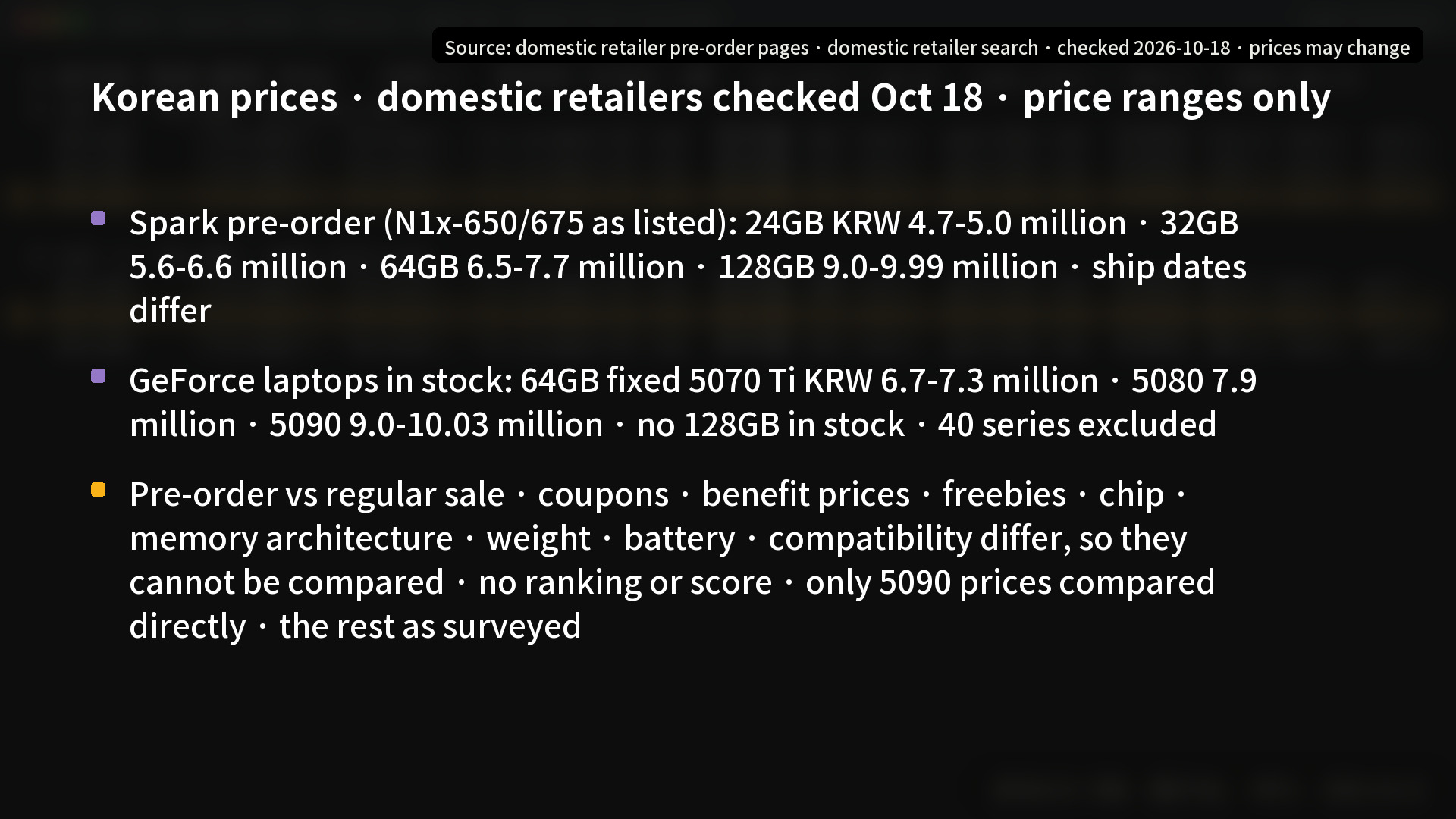
| Configuration | RTX Spark pre-order | GeForce laptops (in stock, fixed RAM) |
|---|---|---|
| 64GB | KRW 6.5-7.7 million | 5070 Ti KRW 6.7-7.3 million, 5080 7.9 million, 5090 9.0-10.03 million |
| 128GB | KRW 9.0-9.99 million | none in stock |
Spark 24GB was KRW 4.7-5.0 million and 32GB was KRW 5.6-6.6 million. Pre-orders, coupons, freebies, chips, memory architecture, weight and battery all differ, so we assign no ranking or score. The MacBook Pro 14-inch M5 Max (40-core GPU) with 128GB and 2TB was KRW 11.41 million in the Apple Korea store. Prices may change.
Compatibility and stability: two separate reports
For compatibility, there are working reports for llama.cpp, Ollama and LM Studio, and none for Strata. Stability comes from two different cases. In StorageReview, the Surface shut off three times on the evening of October 14 under an OpenBLAS numerical load, while the HP finished the same load. The Register's HP, in inference that ran for about an hour, went over 90°C on the GPU with screen corruption and occasional freezes, and was stable after resting. The loads and machines differ, so we do not read them as one.
Limits
- We could not measure RTX Spark, and the DGX Spark (GB10) values we measured are not RTX Spark.
- Other people's reviews differ in software, quantization and machine, so they cannot be compared directly. These are launch-time materials, independent reviews were still few, and in Korea pre-orders meant the shipping date varied by product.
- This post is a framework for choosing, not a verdict. The video said it would update its description when new material appears, so check there for the latest values.
Reference date: 2026-10-19 (video published 2026-10-20). Prices and reviews that changed afterward are not reflected.