GLM-5.3 Flash vs Qwen 3.8 Flash-Next Benchmark: Mac mini 32GB and RTX PRO 6000
Posted Video released
We measured GLM-5.3 Flash and Qwen 3.8 Flash-Next at the same 4-bit on a Mac mini 32GB and two servers: will it run, speed, and 40 Korean questions, with measurements and estimates kept apart.
Before asking which of GLM-5.3 Flash and Qwen 3.8 Flash-Next is better, we first looked at "will it run on my Mac or my PC?" On a Mac mini M6 32GB, we loaded the 93.7GB Flash-Next by reading pieces from the SSD and got 5.7 tokens per second; on two servers rented from the cloud, we measured both models' speed and 40 Korean questions at the same 4-bit. This post rewrites the content of our YouTube video, separating our measurements, other people's measurements, and calculations or estimates.
Conclusions first
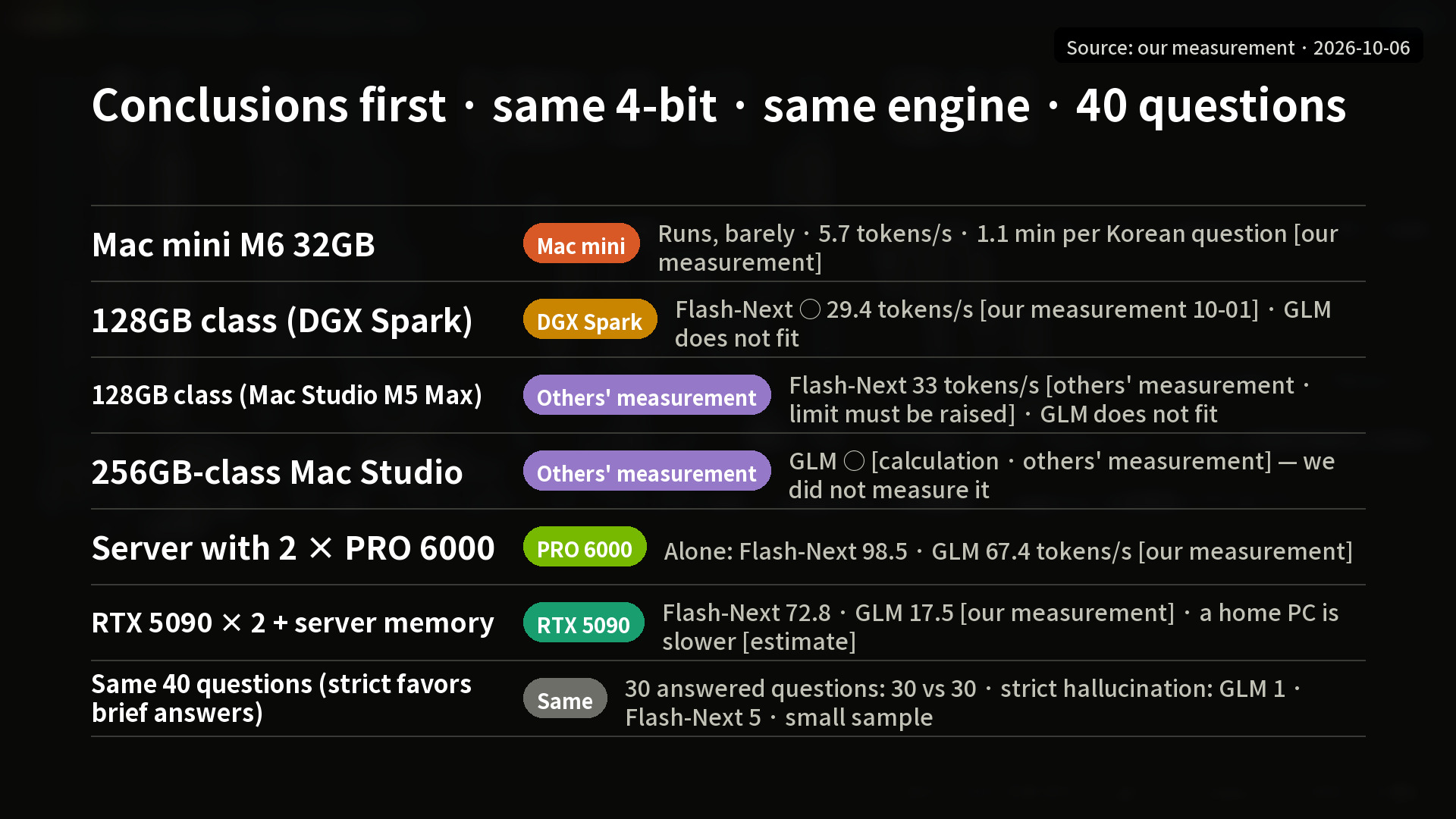
- On a 32GB Mac mini, Flash-Next does run, but a short Korean question takes a median of 1.1 minutes. GLM is 156.8GB, so we did not download it.
- The video's reading: Flash-Next is comfortable on a DGX Spark or a 128GB-class Mac Studio, and GLM needs a 256GB-class machine.
- On the 30 questions with answers, both models got all 30. On the strict criterion, which also counts side facts added after the answer, of the 5 hallucination questions, GLM passed 1 and Flash-Next passed 5, a criterion that favors the side that answers briefly.
- Used alone on a server, Flash-Next runs at 98.5 tokens per second and GLM at 67.4. With two RTX 5090s plus server memory, it is 72.8 versus 17.5 tokens per second.
What kind of numbers these are
| Label | Meaning |
|---|---|
| Our measurement | Measured directly on the Mac mini M6 32GB, two rented servers, and the DGX Spark (2026-10-01) |
| Others' measurement | Public sources such as heretik.io and sleepingrobots. Do not compare directly with our conditions |
| Calculation / estimate | The fit table (file size plus conversation-memory space) and the estimate that a home PC would be slower |
| Price | Values shown in the video as of 2026-10-01. Anything not confirmed is marked unconfirmed |
Why this order
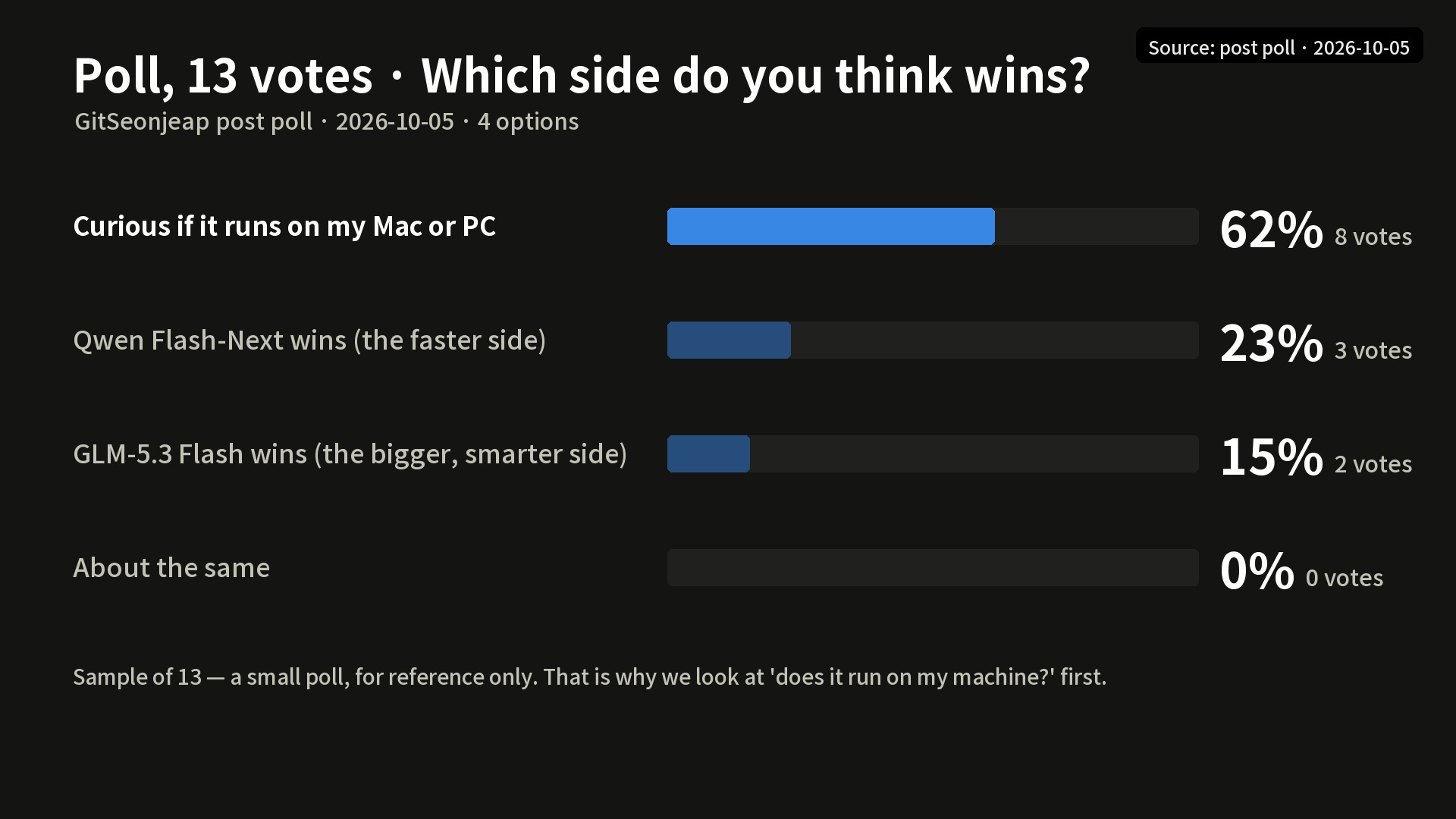
The video came from a poll. Of 13 voters, 8 (62%) chose "more curious whether it runs on my Mac or PC", 3 chose "Qwen wins", and 2 chose "GLM wins". The sample is small and only for reference, but that is why we looked at whether it runs on your machine before who wins.
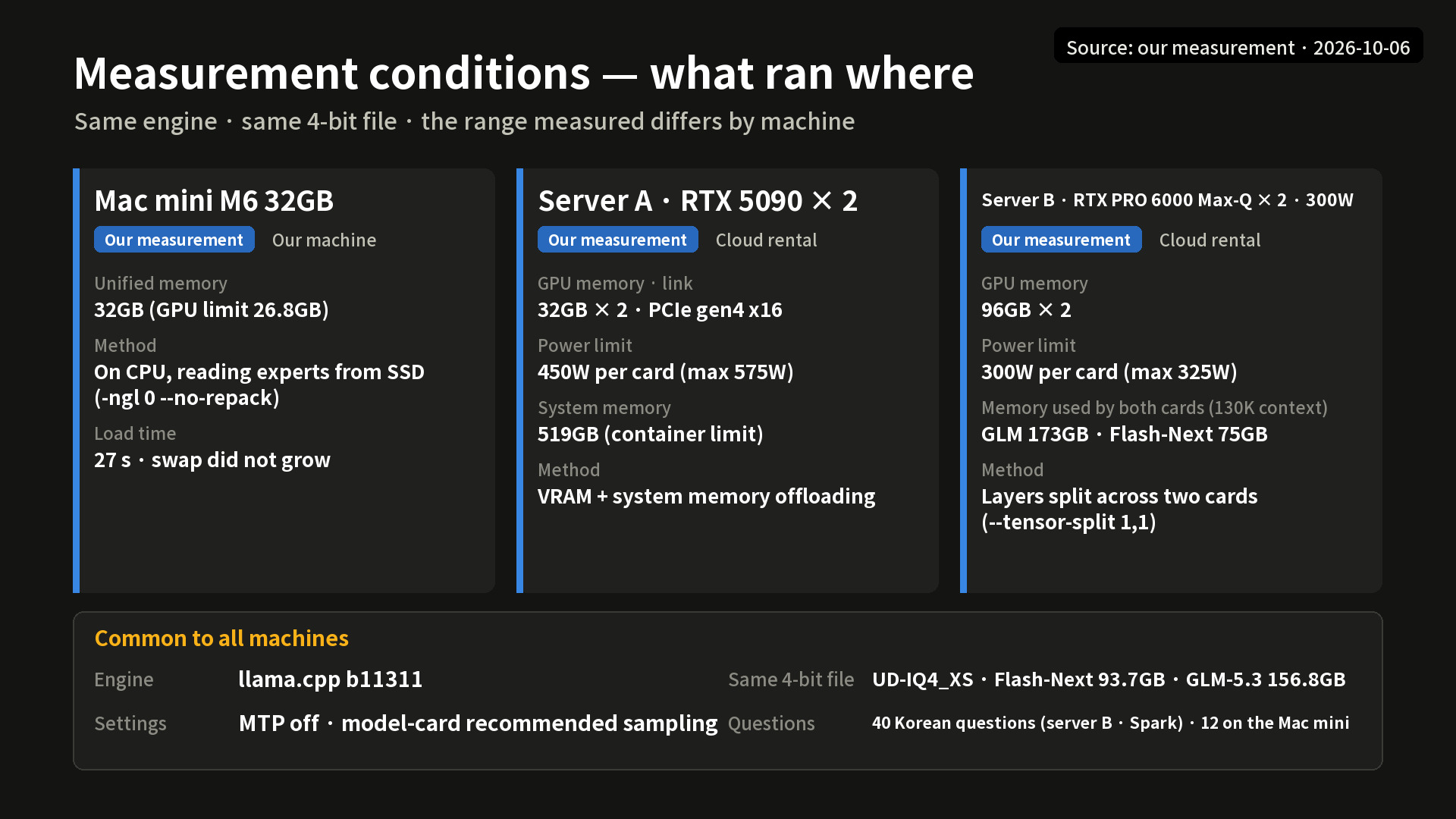
There are three measurement sites. The Mac mini is a machine we own, and the two servers were rented from the cloud. Our first post said we would measure on 8 RTX 5090s, but after re-checking rental prices and configurations we switched to 2 RTX PRO 6000 Max-Q. It is the same Blackwell chip family, and the files, engine, and questions are unchanged. We also measured separately a configuration with two 5090s plus system memory.
The two models and measurement conditions
GLM-5.3 Flash has 320 billion parameters in total with 18 billion active, and its 4-bit file is 156.8GB. Qwen 3.8 Flash-Next has 125 billion with 6 billion active, 93.7GB, and is an experimental preview. Both were set to the same 4-bit (UD-IQ4_XS, from unsloth) on llama.cpp build 11311 with MTP off, sampling at each model card's recommended values, and thinking set to max for GLM and xhigh for Flash-Next.
Will it run on my machine? (calculation)
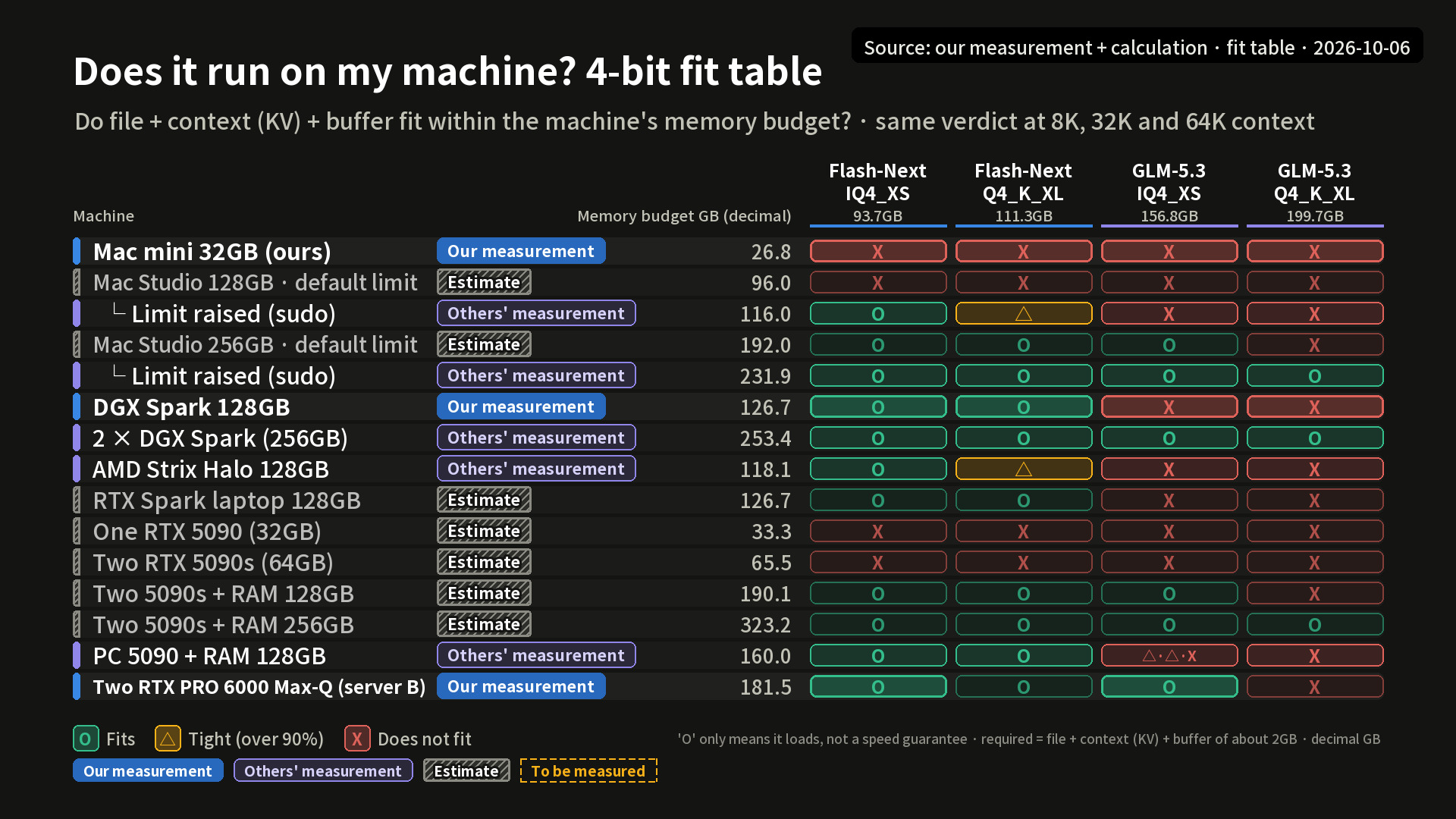
This is a calculation of file size plus conversation memory (KV) and buffers; bold cells are what we actually loaded, and faded cells are calculations or others' measurements. A Mac mini at 16, 24, or 32GB cannot run either model. Among 128GB-class machines, the DGX Spark can load Flash-Next, while a 128GB Mac Studio needs its memory limit raised. GLM needs 256GB class and up; one or two 5090s need extra system memory, and a 64GB machine cannot run either. An O in the table only means it loads, not a speed guarantee.
Mac mini 32GB measurement
The GPU limit is 26.8GB and the file is 93.7GB. The first approach exceeded 12.4GB of swap and stopped automatically; switching to having the CPU read the file from the SSD directly loaded it in 27 seconds without swap growing. Answer-writing speed is 5.7 tokens per second and question-reading speed is 14.8 tokens per second. Twelve short Korean questions took a median of 1.1 minutes each, and because that used a reduced-thinking setting, we do not compare it with the server scores. We expect GLM would be slower in the same way, but that is not a measured value.
Server B: two RTX PRO 6000 Max-Q (300W)
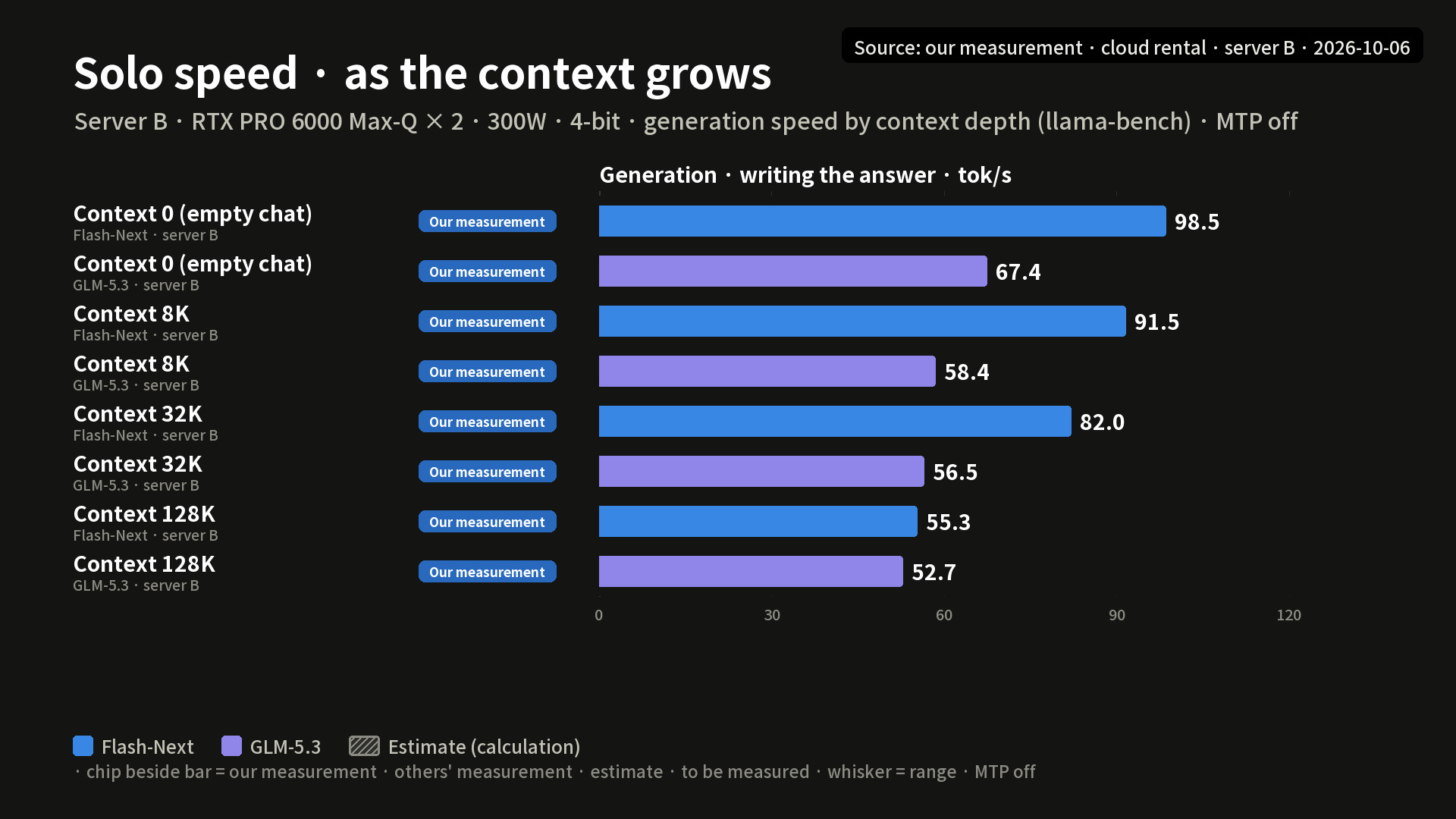
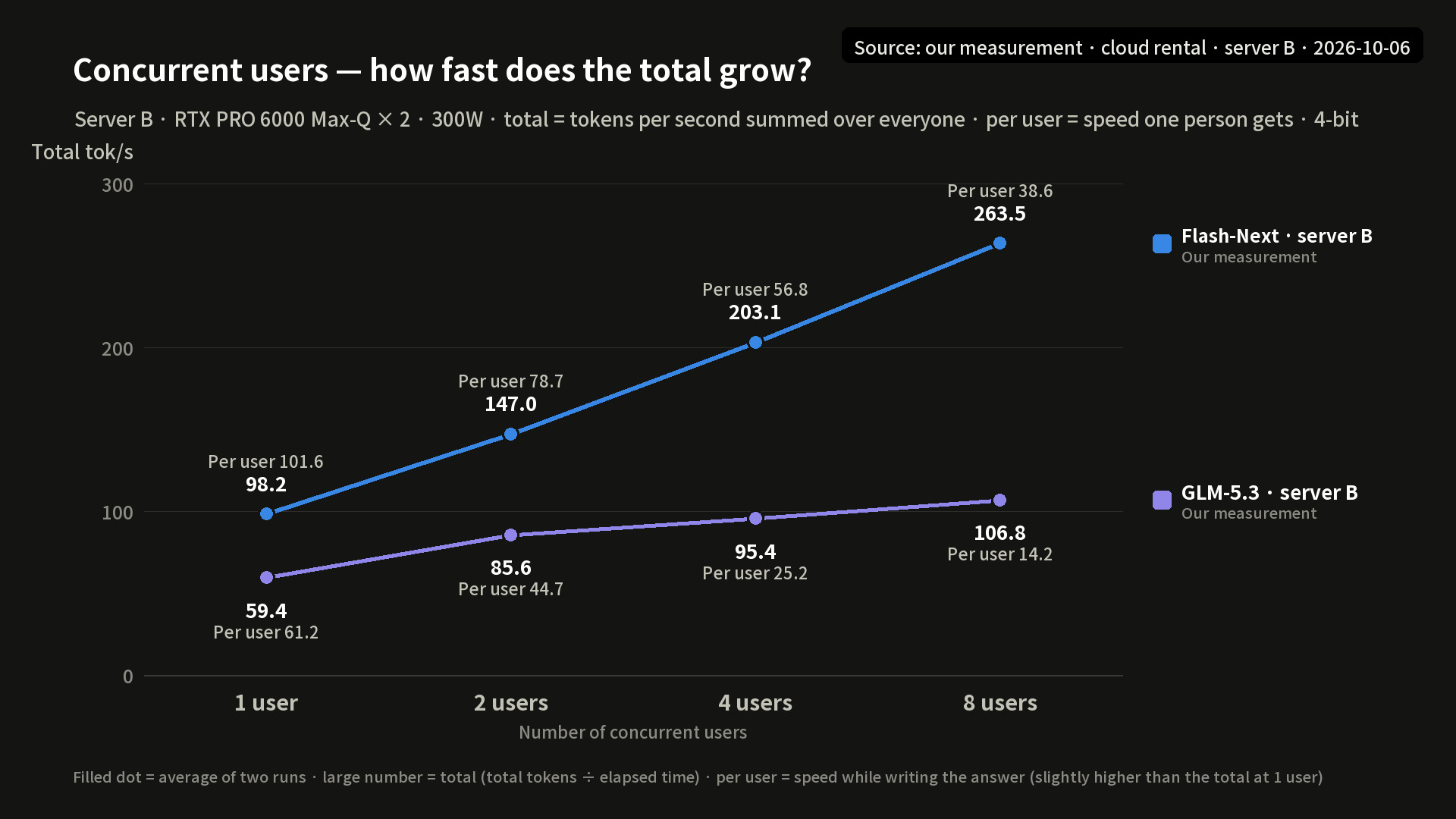
With a 130K-token context and 8 concurrent users, the two cards used 173GB for GLM and 75GB for Flash-Next.
| Condition | Flash-Next | GLM-5.3 |
|---|---|---|
| Alone, empty context (tok/s) | 98.5 | 67.4 |
| Context 8K | 91.5 | 58.4 |
| Context 32K | 82.0 | 56.5 |
| Context 128K | 55.3 | 52.7 |
| 8 concurrent users, total / per user | 263.5 / 38.6 | 106.8 / 14.2 |
As the number of concurrent users grows, total throughput went 98.2, 147.0, 203.1, 263.5 tokens per second for Flash-Next at 1, 2, 4, 8 users, and 59.4, 85.6, 95.4, 106.8 for GLM (average of two runs).
The same 40 questions (our measurement + AI judging)
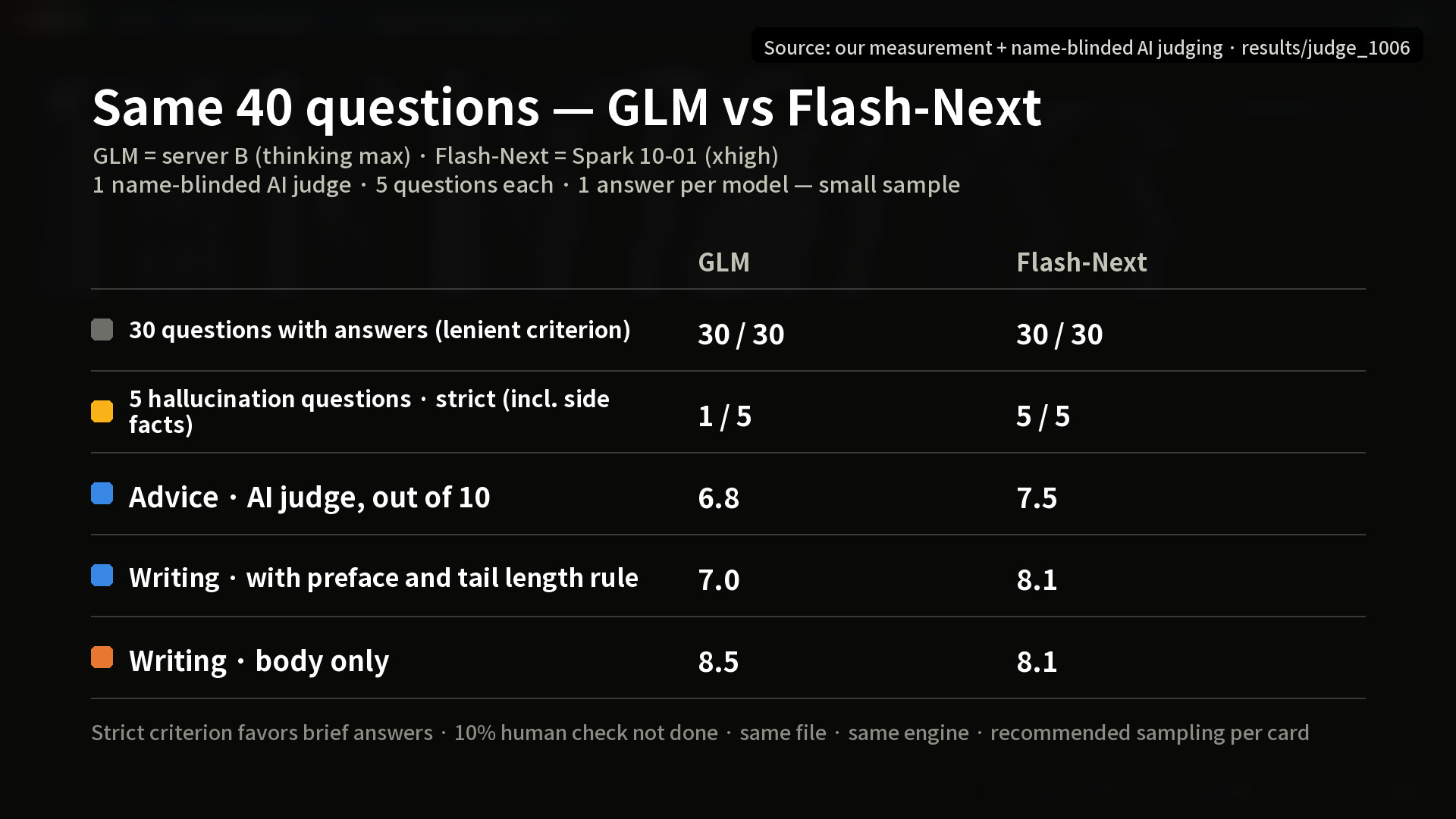
GLM was solved on server B and Flash-Next on the DGX Spark on October 1, with 5 questions per task. We could not re-solve on the server to confirm that the same score holds across different machines. For example, on t4_18 GLM added "Cheorwon-eup Dolmeori" after the answer, but the official address is Dongsong-eup. Flash-Next answered briefly and made almost no added claims, which is why the strict criterion favors the side that answers briefly.
| Item | GLM | Flash-Next |
|---|---|---|
| 30 questions with answers (lenient criterion) | 30 / 30 | 30 / 30 |
| Passed, of 5 hallucination questions, strict (including side facts) | 1 / 5 | 5 / 5 |
| Advice (name-blinded AI judge, out of 10, average of two runs) | 6.8 | 7.5 |
| Writing (with preface and tail length rule) | 7.0 | 8.1 |
| Writing (body only) | 8.5 | 8.1 |
| Median thinking tokens | 439 | 680 |
There was one judge, 5 questions each, and 1 answer per model, with no human check, so the sample is small.
Two RTX 5090s + system memory, and other machines
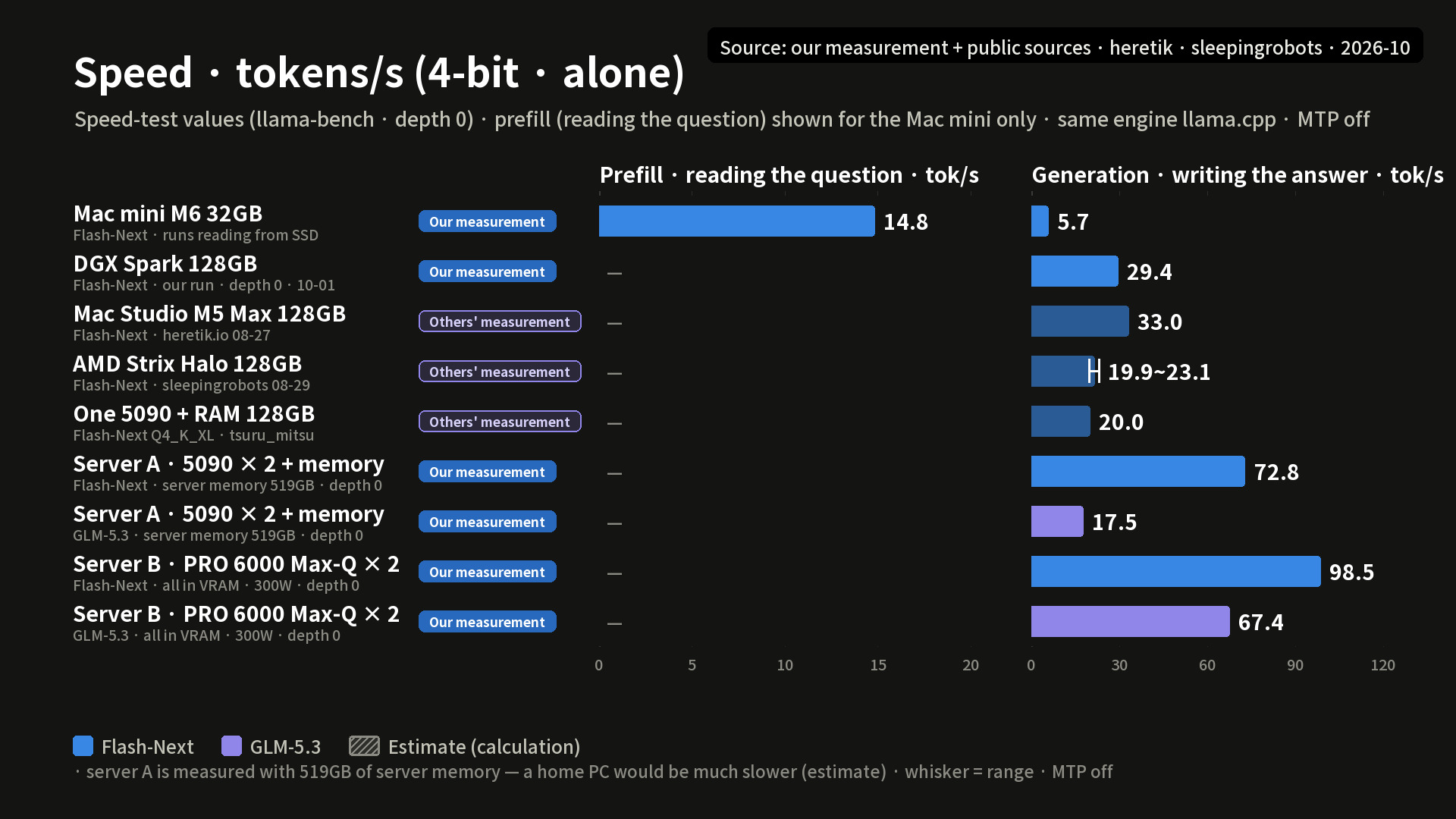
The rented server A has a 519GB system-memory limit for its container, much larger than a configuration you would buy for home. Running some experts from memory, Flash-Next gets 72.8 tokens per second and GLM 17.5. This server's memory read bandwidth is 610GB per second, and a home computer is at about one-eighth to one-tenth of that, so it should be much slower; this is an estimate, not a measured value.
| Machine (alone, answer-writing tok/s) | Flash-Next | GLM-5.3 | Type |
|---|---|---|---|
| Mac mini M6 32GB (reading from SSD) | 5.7 | not downloaded | Our measurement |
| DGX Spark 128GB (10-01) | 29.4 | does not fit | Our measurement |
| Server A: 2 5090s + 519GB memory | 72.8 | 17.5 | Our measurement |
| Server B: 2 PRO 6000 Max-Q | 98.5 | 67.4 | Our measurement |
| Mac Studio M5 Max 128GB | 33.0 | does not fit | Others' measurement (heretik.io, 08-27) |
| AMD Strix Halo 128GB | about 20-23 | - | Others' measurement (sleepingrobots, 08-29) |
The DGX Spark value is from a speed test, and its 8-user total is about 66 tokens. The video noted that GLM's 59-91 tokens on a 256GB Mac used speculative decoding and cannot be compared, and that RTX Spark had not been released yet.
Prices and the video's summary (as of 2026-10-01)
The prices listed in the video are DGX Spark 128GB at KRW 9.5 million (Danawa), an RTX 5090 card from KRW 8.25 million (KRW 16.5 million or more for two), and a Mac Studio 256GB at KRW 16.29 million (calculated from Apple Korea's configurator), all in Korea. We could not confirm the price of 128GB of memory, a motherboard, or a power supply. Based on those prices, the video groups the options as follows: a 32GB Mac mini cannot load either model, so a 27B-class model is the realistic range; with a budget of around KRW 9.5 million, a DGX Spark or a 128GB Mac Studio loads only Flash-Next, and a 256GB-class Mac Studio loads GLM too; a PC that also serves gaming and image generation could add memory to a 5090 and run only Flash-Next (slowly); and at around KRW 3 million, a used 3090 with a 27B-class model. This post is not a recommendation to buy or choose any machine.
Limits and reference date
- The 40 Korean questions used one judge, 5 questions each, 1 answer per model, with no human check. GLM and Flash-Next were solved on different machines.
- The Mac mini has no GLM value, and the two-5090 value came from a server whose memory is much faster, so we estimate a home PC would be slower.
- Others' measurements have different conditions, so we do not compare them directly. The Qwen side is an experimental preview.
- Reference date: measured 2026-10-06, video published 2026-10-07, prices 2026-10-01 (as of the video's publication; they may have changed since).