RTX PRO 6000 Slower Than the 4090? MiniMax H3 GPU Test
Posted Video released
We ran the same AI video on an RTX 3090, 4090, 5090 and PRO 6000. With int8 the 4090 was fastest, and the PRO 6000 won only with the original bf16. Speed, power and rental cost.
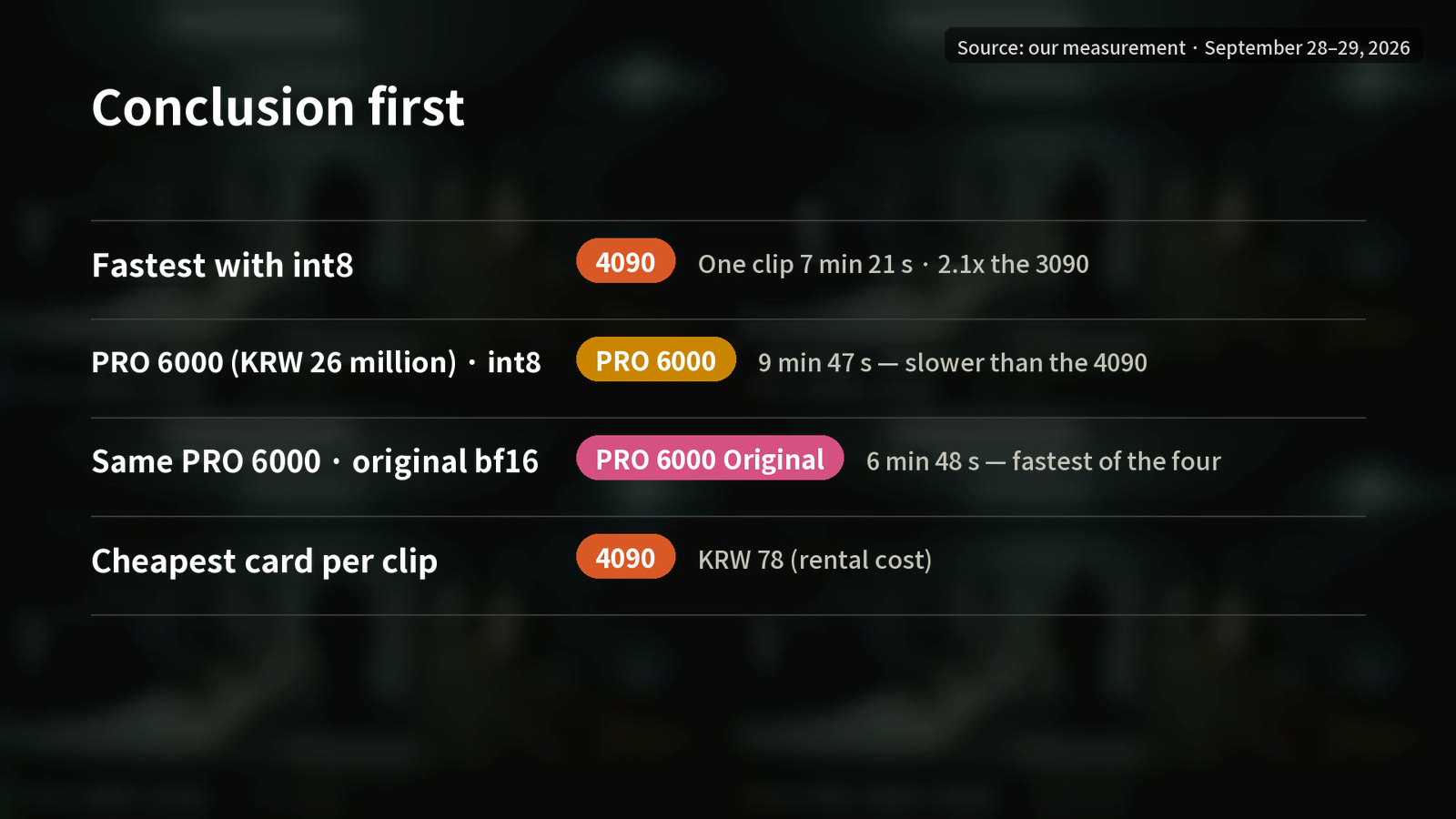
We generated the same AI video on an RTX 3090, 4090, 5090 and RTX PRO 6000, and the most expensive card, the PRO 6000 (about KRW 26.2 million in Korea, the lowest new-product price on Danawa on the video's reference date, 2026-09-29), was slower than the 4090 with int8 settings. For one clip of about 6 seconds, the 4090 took 7 min 21 s and the PRO 6000 took 9 min 47 s. Switching the same PRO 6000 to the uncompressed original (bf16) model brought it to 6 min 48 s, the fastest of the four. This post reorganizes the measurements from the YouTube video so they are easier to read.
Conclusions first
- With int8 settings the fastest card was the 4090. At 7 min 21 s per clip it ran 2.1 times as fast as the 3090 (15 min 12 s).
- The PRO 6000 took 9 min 47 s with int8, slower than the 4090, and the 5090 took 10 min 20 s.
- Switching the same PRO 6000 to the original bf16 model gave 6 min 48 s. The original video model alone is 66GB, so it cannot be loaded on a 24GB or 32GB card.
- Counted as rental cost, the 4090 was cheapest at KRW 78 per clip.
- Image quality differed only in small details from card to card. We found no difference large enough to rank by eye.
The numbers in this post come in four kinds
| Label | Meaning |
|---|---|
| Our measurement | Values we measured ourselves on four rented cloud servers (2026-09-28 to 29) |
| Price survey | Lowest new-product prices on Danawa and used-market asking prices (surveyed 2026-09-29) |
| Calculation / estimate | 80-clip projection, currency conversion (USD 1 = KRW 1,365.1, September 28 close), purchase price ÷ hourly rental rate |
| Guess | Hypotheses about causes. Not verified directly |
How we measured
We used MiniMax H3 (an AI video generation model) at 1344x768, 20 steps without LoRA, to make a convenience-store scene at three in the morning. There are three clips: a close-up with dialogue, a wide shot with three people, and a canned-coffee insert. Each clip used two seeds, so each card produced 6 runs. The prompts, reference images and seeds are identical on all four servers. The video model was the int8-compressed version, the text encoder was nvfp4, the VAE was int8, and SageAttention was left on at 1.0.6, which came with the server template.
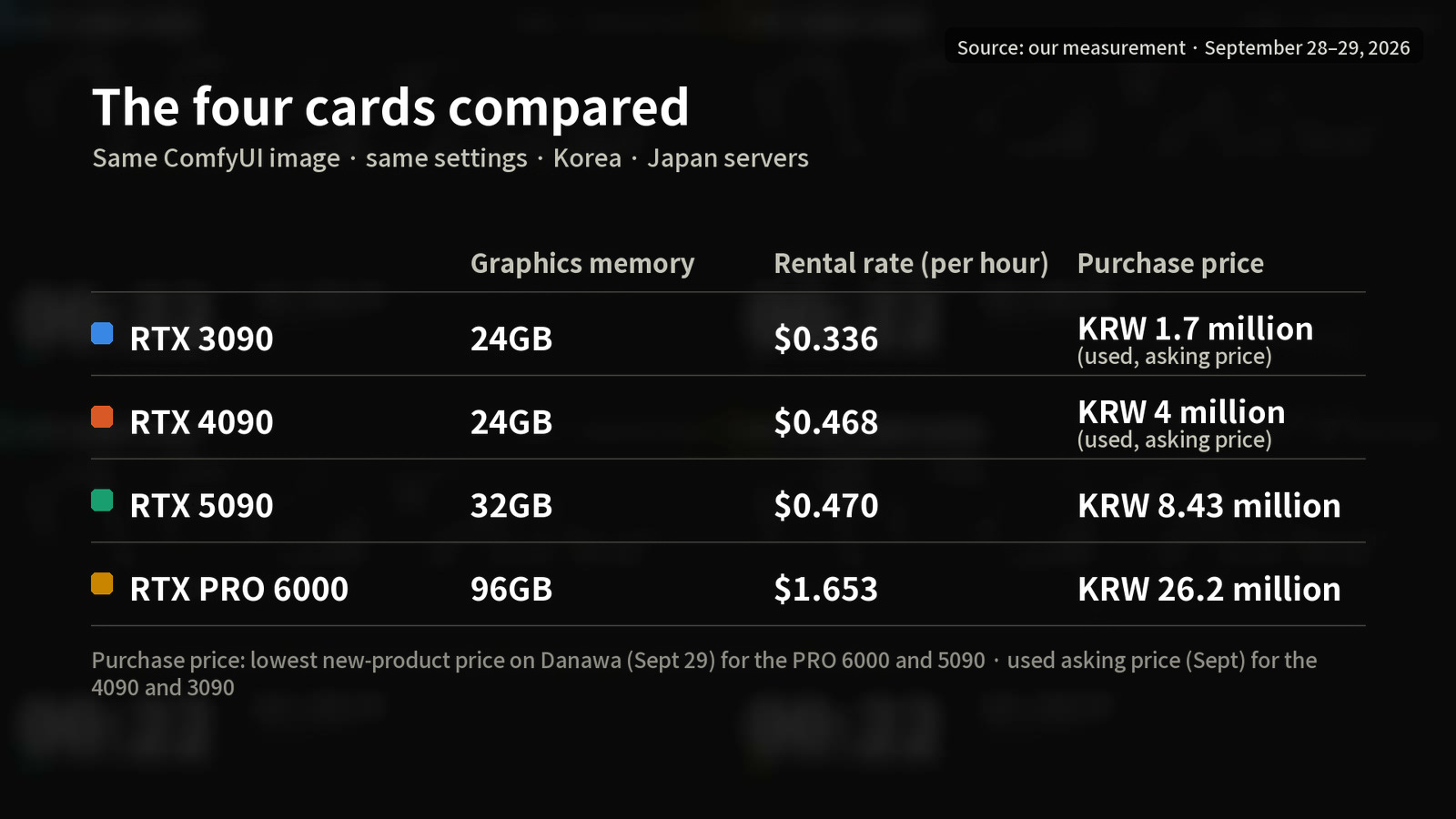
The ComfyUI in the server template was an old version without H3 nodes, so we upgraded all four servers to the same latest version (0.37.4) before measuring. Hourly rental rates were USD 0.336 for the 3090, USD 0.468 for the 4090, USD 0.470 for the 5090 and USD 1.653 for the PRO 6000. The total rental bill, including failures and retries, was USD 12.96.
Speed: how many minutes each card took
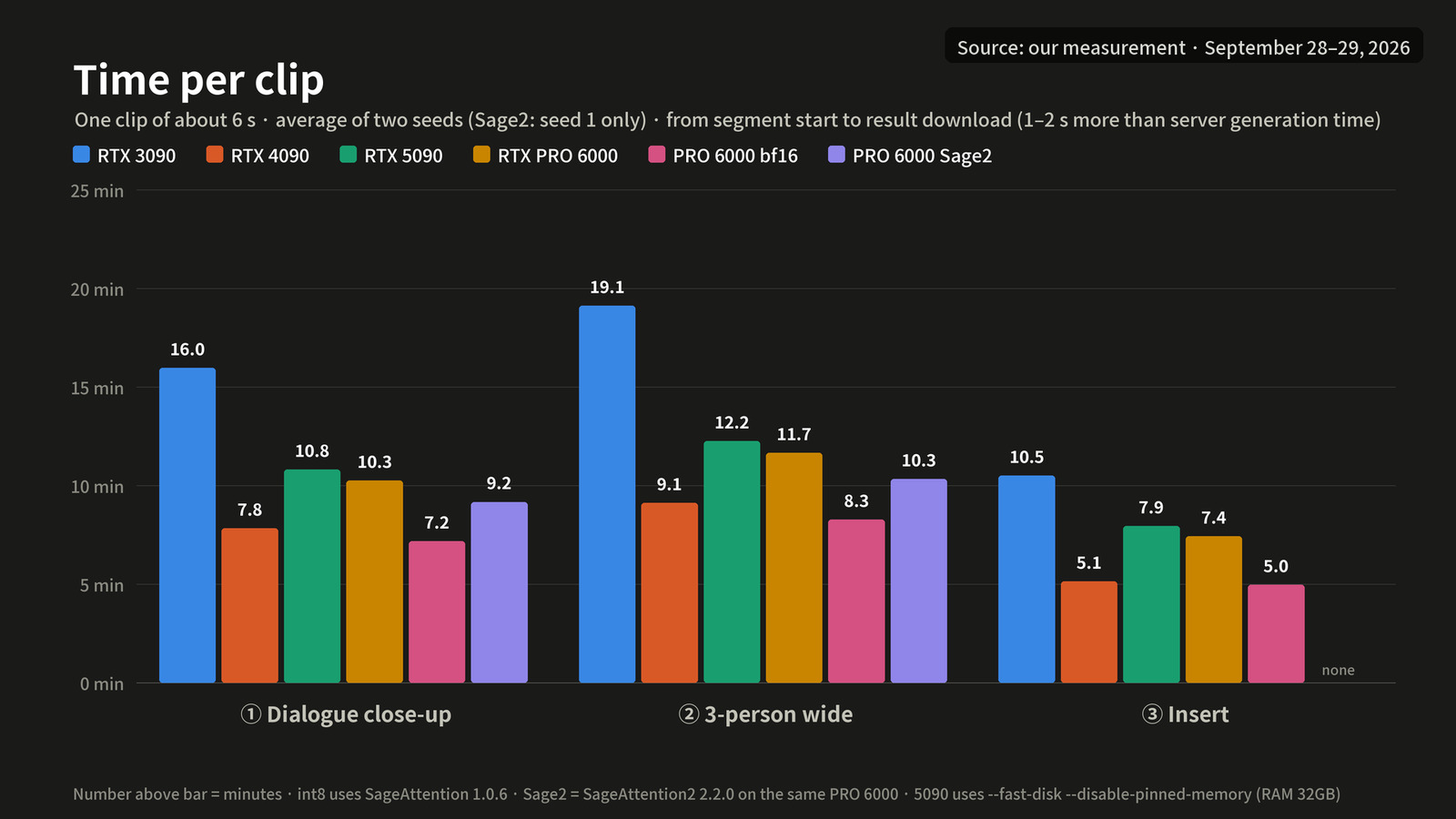
Here are the averages per clip (about 6 seconds). The multiple versus the 3090 is the ratio of total time over the same segments and seeds.
| GPU (setting) | Time per clip | vs. 3090 |
|---|---|---|
| RTX 4090 (int8) | 7 min 21 s | 2.07x |
| RTX PRO 6000 (int8) | 9 min 47 s | 1.55x |
| RTX 5090 (int8) | 10 min 20 s | 1.47x |
| RTX 3090 (int8) | 15 min 12 s | 1.00x |
| RTX PRO 6000 (original bf16) | 6 min 48 s | 2.24x |
One wide-shot clip took 9 min 6 s on the 4090 and 19 min 7 s on the 3090. The 4090 also finished all three clips first, in about 22 minutes, while the 3090 needed about 46 minutes.
Why the expensive card was slower: three guesses and two direct tests
The video offered three guesses. First, an int8-compressed model seems to add the work of decompressing during computation. Second, SageAttention 1.0.6 in the template is not a version built for the new Blackwell chips (PRO 6000, 5090). Third, the 5090 server has only 32GB of system memory, so it was launched with the --fast-disk --disable-pinned-memory options, which makes its conditions differ from the other servers. These three are guesses, and two of them were tested directly on the PRO 6000.
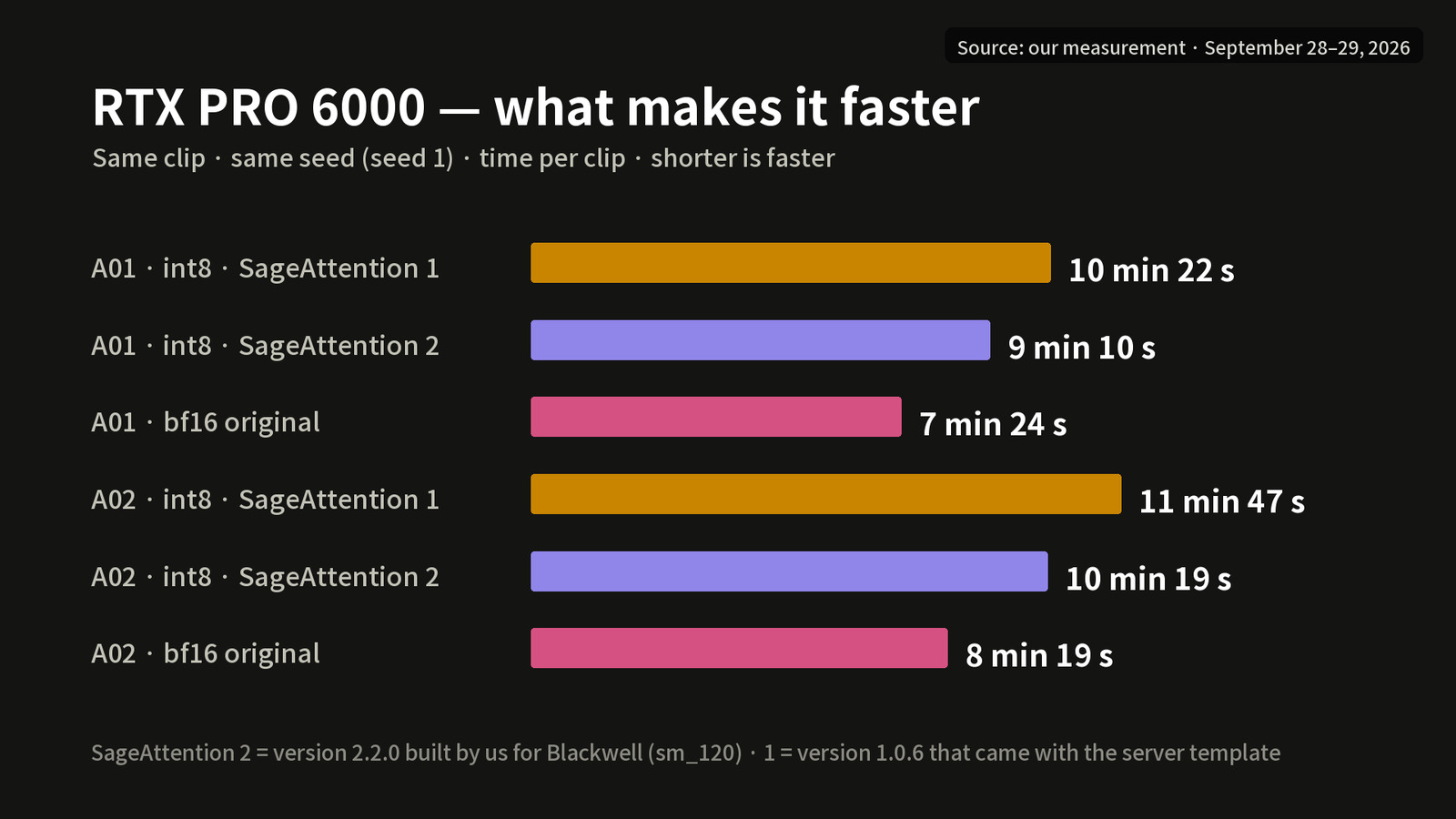
- After building SageAttention 2.2.0 for Blackwell and swapping it in, the dialogue clip dropped from 10 min 22 s to 9 min 10 s, about 12% (+12.1% over two clips; this test used seed 1 of two clips only).
- Switching to the original bf16 cut the same clip to 7 min 24 s, about 29%. Over all 6 runs it fell from 58.7 to 40.8 minutes, about 30% (1.44x).
Swapping to the original model had a bigger effect than swapping the attention kernel.
What only 96GB allows, and memory and power
The original bf16 needs about 66GB for the video model alone, plus about 51GB for the text encoder. That cannot be loaded on a 24GB or 32GB card, so the setting is possible only on a card with 96GB. The peak VRAM from the 1-second nvidia-smi log during generation was 23.3GB (of 24GB) on the 3090 and 4090, 31.1GB (of 32GB) on the 5090, 75.4GB on the PRO 6000 with int8 and 95.0GB (of 96GB) with the original bf16. For the 5090 and the PRO 6000 with int8, logging started partway through generation, so only some clips are reflected.
Average power was 384W on the 3090, 427W on the 4090, 489W on the 5090 and 541W on the PRO 6000. The PRO 6000 running the original reached 579W, close to its 600W limit.
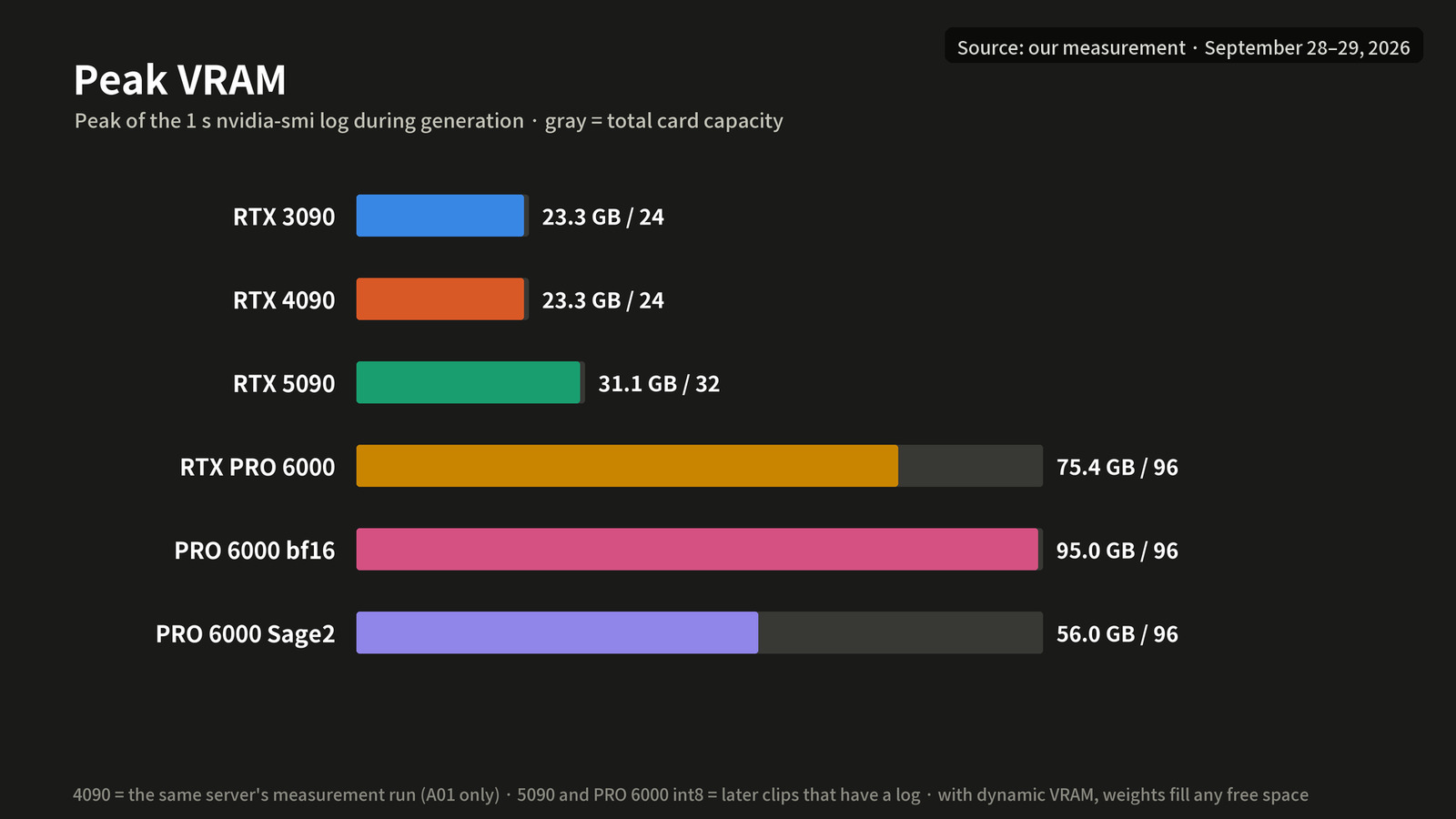
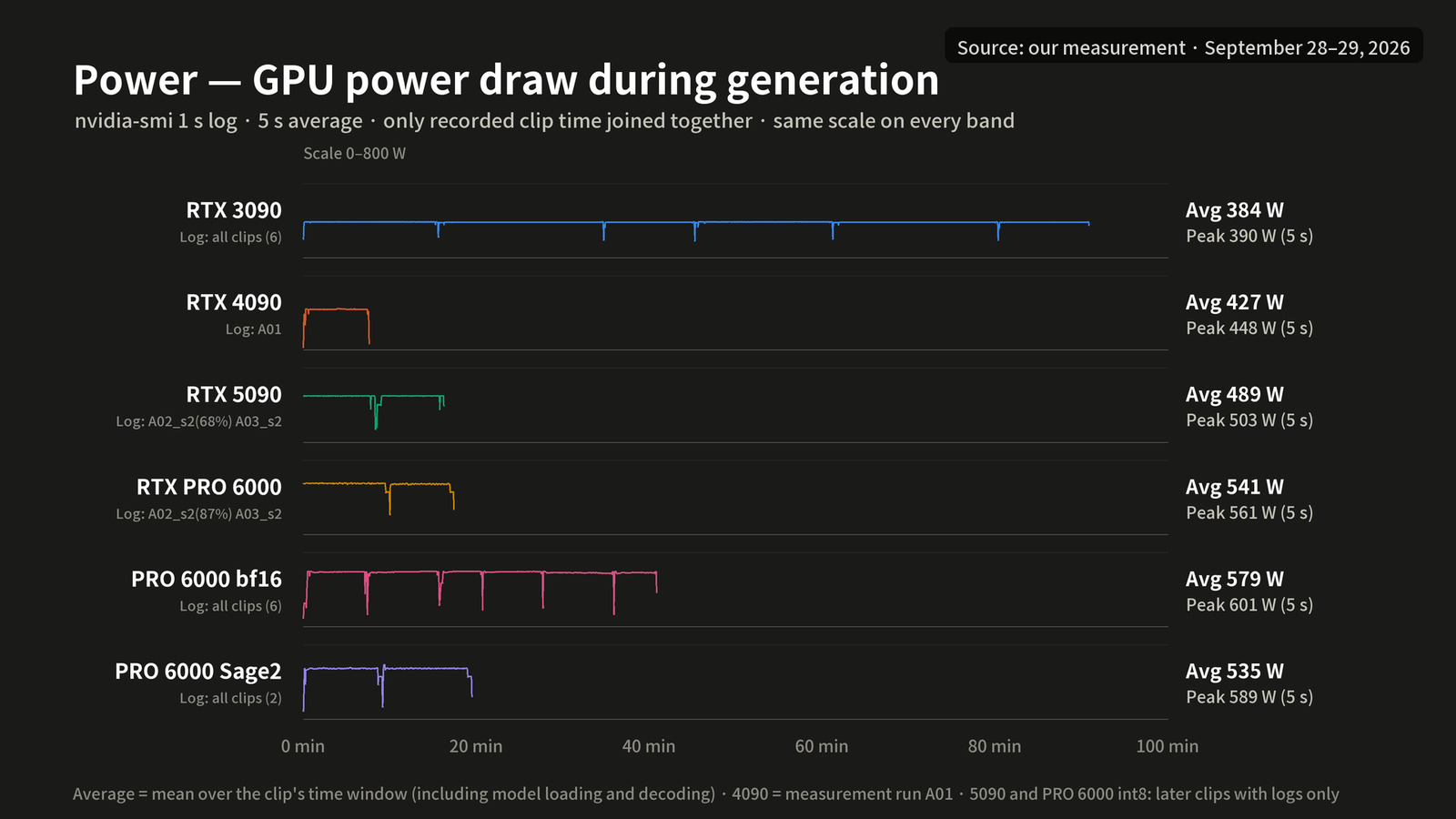
Image quality: we could not pick a sharper one
Even with the same seed, details diverge when the GPU and kernels differ. Using the PRO 6000 int8 run as the reference, the similarity of same-seed frames (SSIM, where 1 is an identical picture) ranged from 0.80 to 0.99, and the clip-and-seed averages were 0.940 for the 3090, 0.938 for the 4090, 0.937 for the 5090 and 0.929 for the PRO 6000 bf16. Composition, motion and characters are the same, and only details change. The mouth movements in the dialogue clip followed the lines in all five versions, and the water-droplet insert on the can started from the first-frame image and was almost identical across the five.
One visible difference stood out. With the first seed, only the int8 version gave a character glasses that were not in the reference image, and the original version had none. For that reason the video did not name a "best image quality" winner and judged them similar.
Two traps when renting
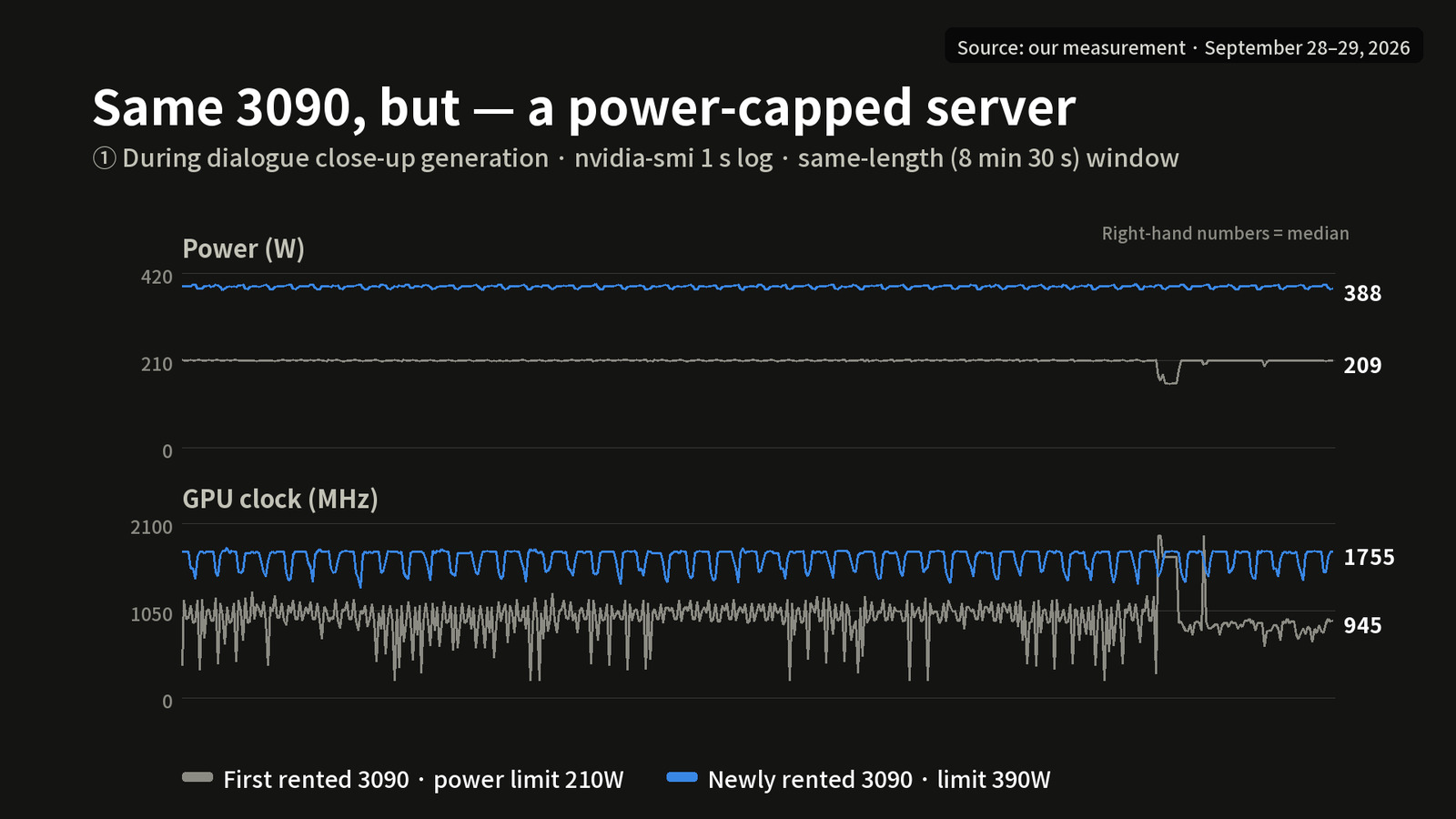
- Power limit: The first 3090 we rented had its power capped at 210W by the server owner (default is 350W). The clock dropped to around 945MHz, and it ran the first clip for more than 47 minutes without finishing, while a newly rented 3090 finished the same clip in 15 min 59 s. The video's advice is to run
nvidia-smi -q -d POWERafter renting and check that Current Power Limit matches Default. - Old ComfyUI: The ComfyUI in the server template had no H3 nodes, so it had to be upgraded to the latest version.
Cost: counted as rental money
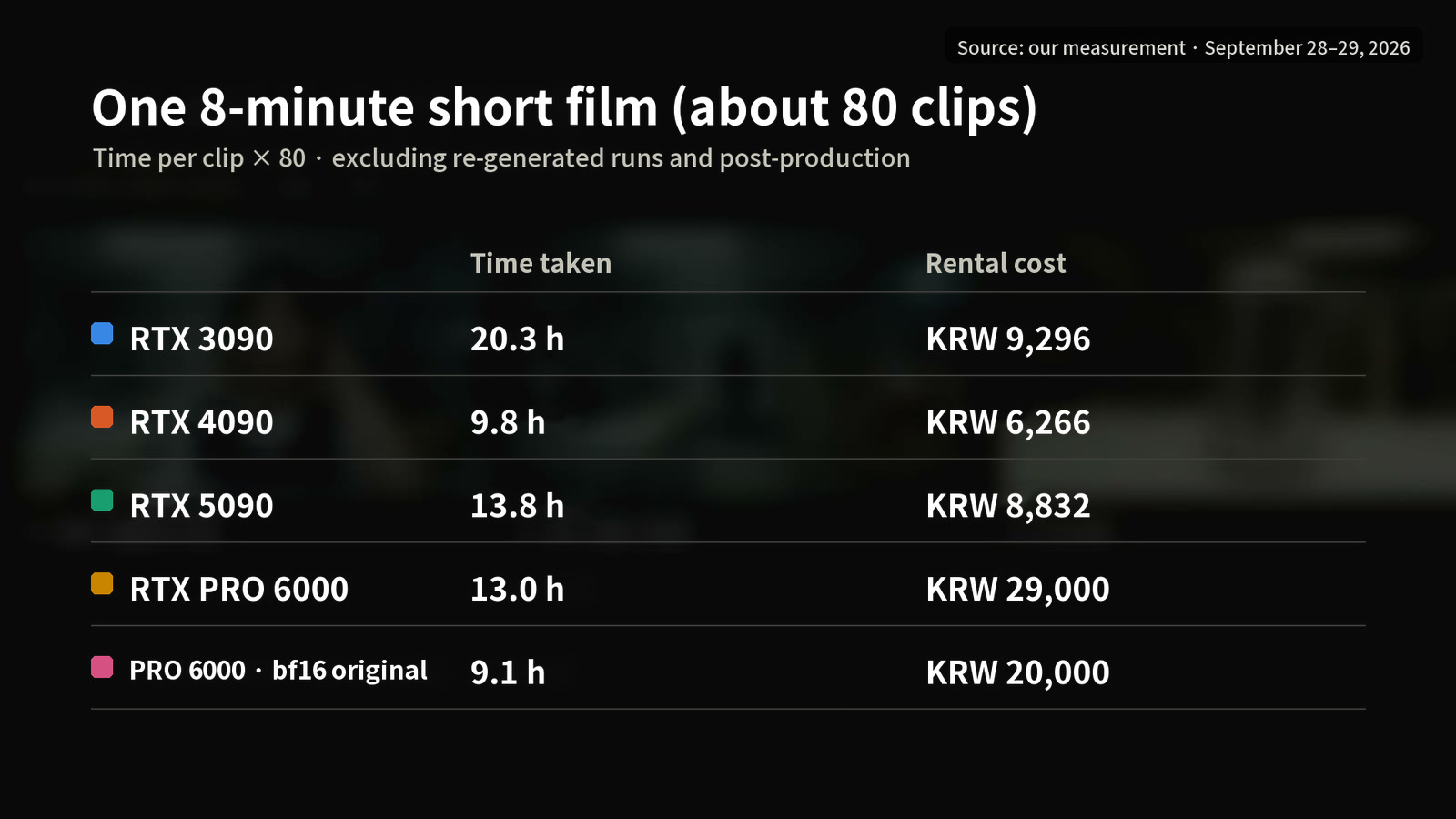
The rental cost per clip was KRW 78 on the 4090, KRW 116 on the 3090, KRW 110 on the 5090 and KRW 368 on the PRO 6000, and KRW 256 when the same PRO 6000 runs the original (hourly rate × time taken, at KRW 1,365.1 per dollar). Projecting an 8-minute short film at about 80 clips gives the following. Re-generated runs and post-production are excluded.
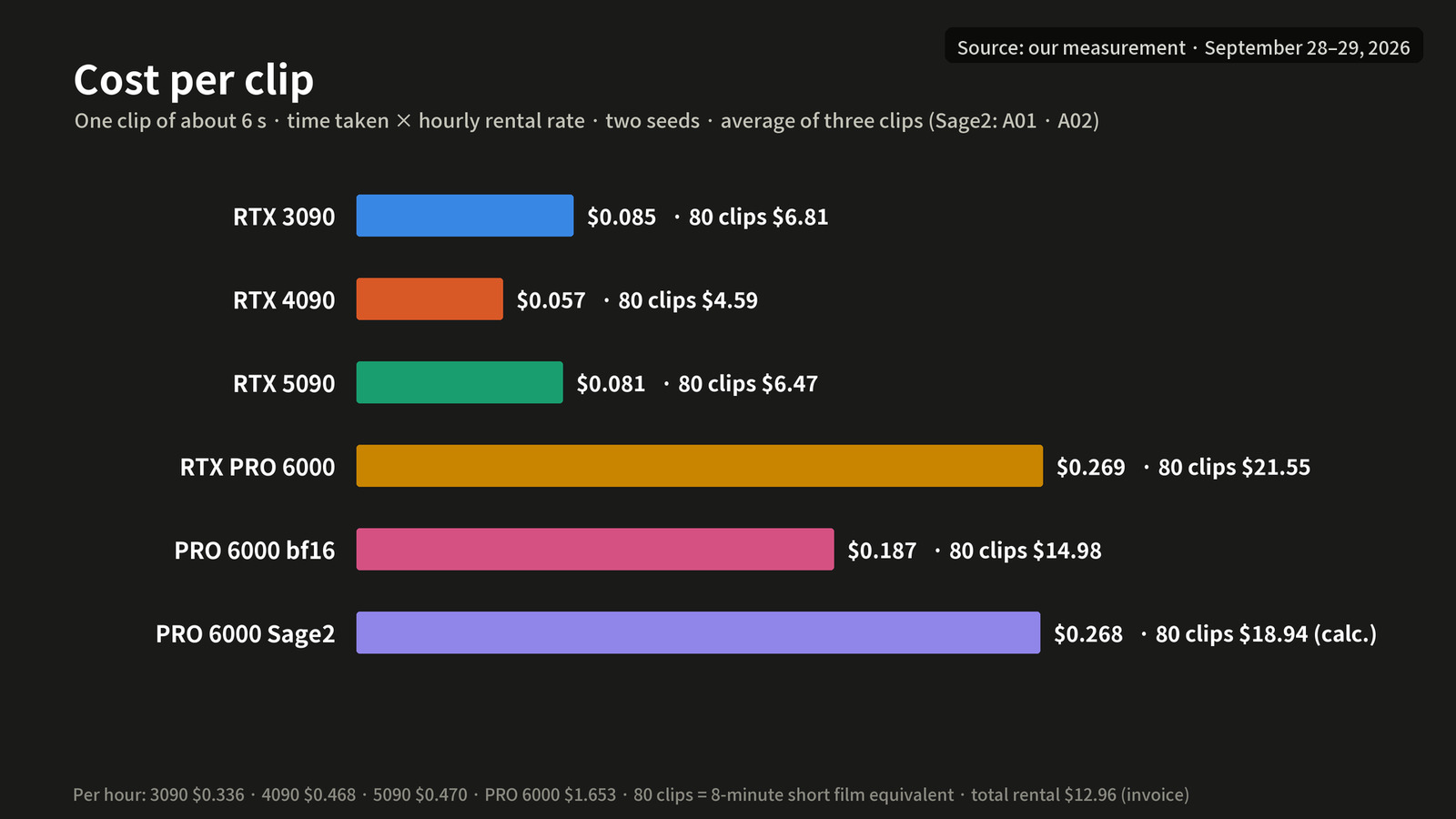
| GPU (setting) | Time for 80 clips | Rental cost for 80 clips |
|---|---|---|
| RTX 3090 | 20.3 h | KRW 9,296 |
| RTX 4090 | 9.8 h | KRW 6,266 |
| RTX 5090 | 13.8 h | KRW 8,832 |
| RTX PRO 6000 (int8) | 13.0 h | about KRW 29,000 |
| RTX PRO 6000 (original bf16) | 9.1 h | about KRW 20,000 |
The video also compared buying with renting. As of its reference date (2026-09-29), the lowest new-product prices on Danawa were KRW 26.2 million for the PRO 6000 and KRW 8.43 million for the 5090. No new 4090 was found, so the used asking price of KRW 4 million is used, and the 3090 is a used asking price of KRW 1.7 million. Dividing the PRO 6000 purchase price by the hourly rental rate of the same card (USD 1.653) gives about 11,611 hours, which is enough time to make about 1,282 eight-minute shorts with the original model. Electricity and resale value are excluded, so this is a calculation / estimate.
The video's verdict
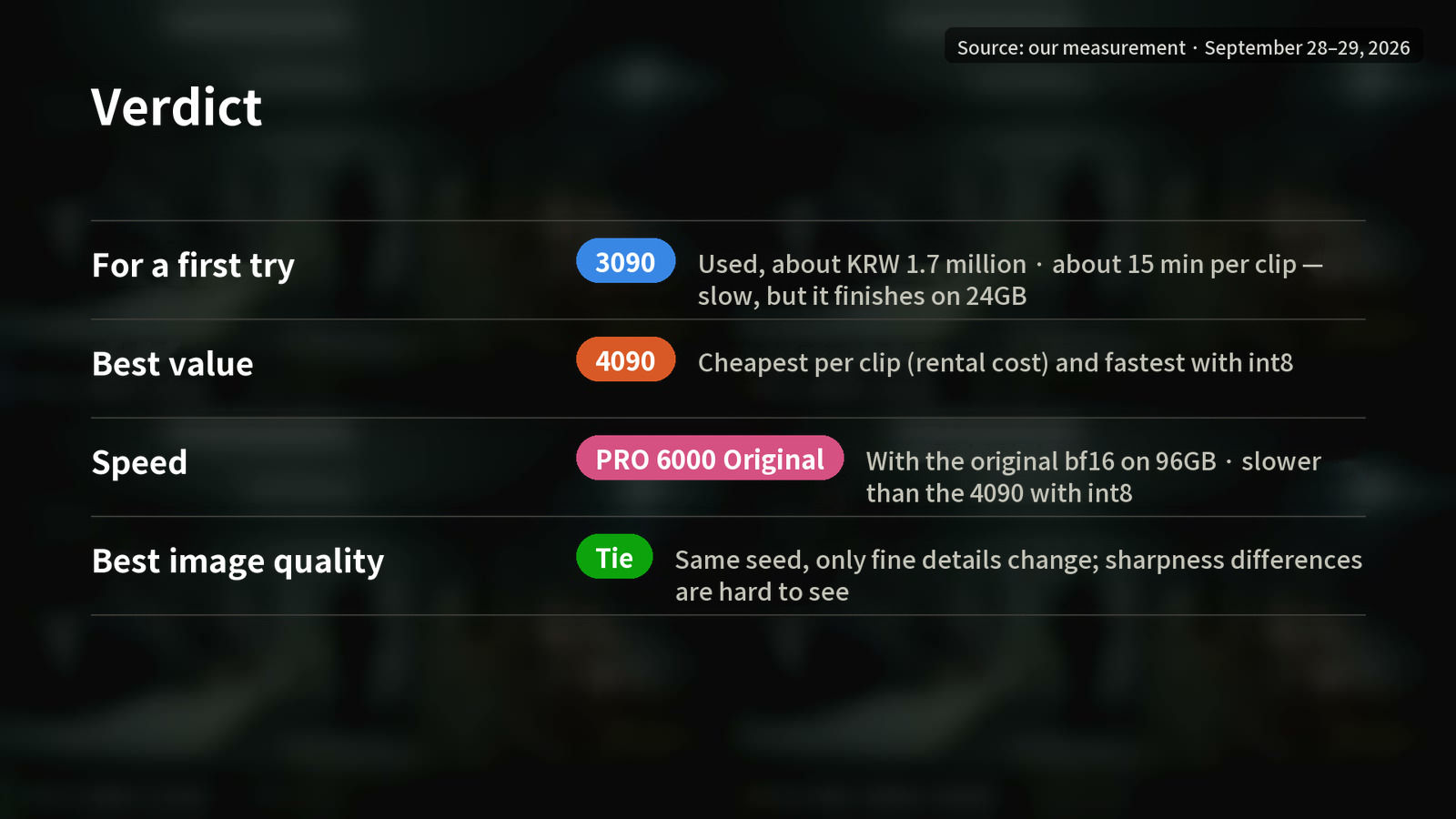
- For a first try, the 3090: about KRW 1.7 million as a used asking price (as of 2026-09-29) and about 15 minutes per clip, but it gets through to the end on 24GB.
- For value, the 4090: the lowest rental cost per clip and the fastest with int8.
- For speed, the PRO 6000 original: when the original bf16 runs on 96GB. With int8 it is slower than the 4090.
- Best image quality: a tie.
Limits and reference dates
- Each clip used only two seeds, so luck can be mixed in.
- Each rented server had different system memory and CPU, and that difference is included in the speed (3090: 125GB RAM, 32 CPU threads; 4090: 251GB, 64; 5090: 30GB, 16; PRO 6000: 503GB, 128).
- The 4090's VRAM and power values come from a separate measurement run in which one clip was regenerated on the same server.
- The SageAttention 2 and bf16 tests were done only on the PRO 6000, and the other cards stayed on the template defaults.
- We compared the generated output as it is, with no upscaling or correction.
- Reference dates: measured 2026-09-28 to 29, prices surveyed 2026-09-29, video published 2026-09-30. Price changes after that are not reflected. This post is not a purchase recommendation.