Strata on Mac mini 32GB: 10.3-22.1 Tokens/s (Thinking On) vs 27B
Posted Video released
Strata on a Mac mini M6 32GB runs Qwen3.8 Flash-Next Q2_0 (66.4GB) at 10.3-22.1 tokens/s (thinking-on format). No accuracy difference confirmed vs 27B 4-bit (150 questions, 52 coding problems).
On a Mac mini M6 32GB, the 66.4GB Qwen3.8 Flash-Next (2-bit Q2_0) file ran on the Strata engine, at 10.3-22.1 tokens/s depending on the question (in the thinking-on format; 17.2-24.0 tokens/s in the thinking-off format). Compared with Qwen3.8 27B 4-bit on the same Mac, we could not confirm a difference in accuracy on 150 questions or on 52 coding problems. What did differ was file size, free memory, and Chinese characters (hanja) mixed into Korean answers.
Strata is an engine that runs a 125-billion-parameter mixture-of-experts model on a 12GB graphics card, and its original developer said Mac is out of scope. The strata-mlx we used is an unofficial, independent project that reads the same model file and runs it on a Mac. This article rewrites the measurements from a 10 min 18 s video (published 2026-10-13), which is narrated in Korean. Every value was measured on one Mac mini on 2026-10-13 with Chrome closed.
Test conditions: the same file, two question formats
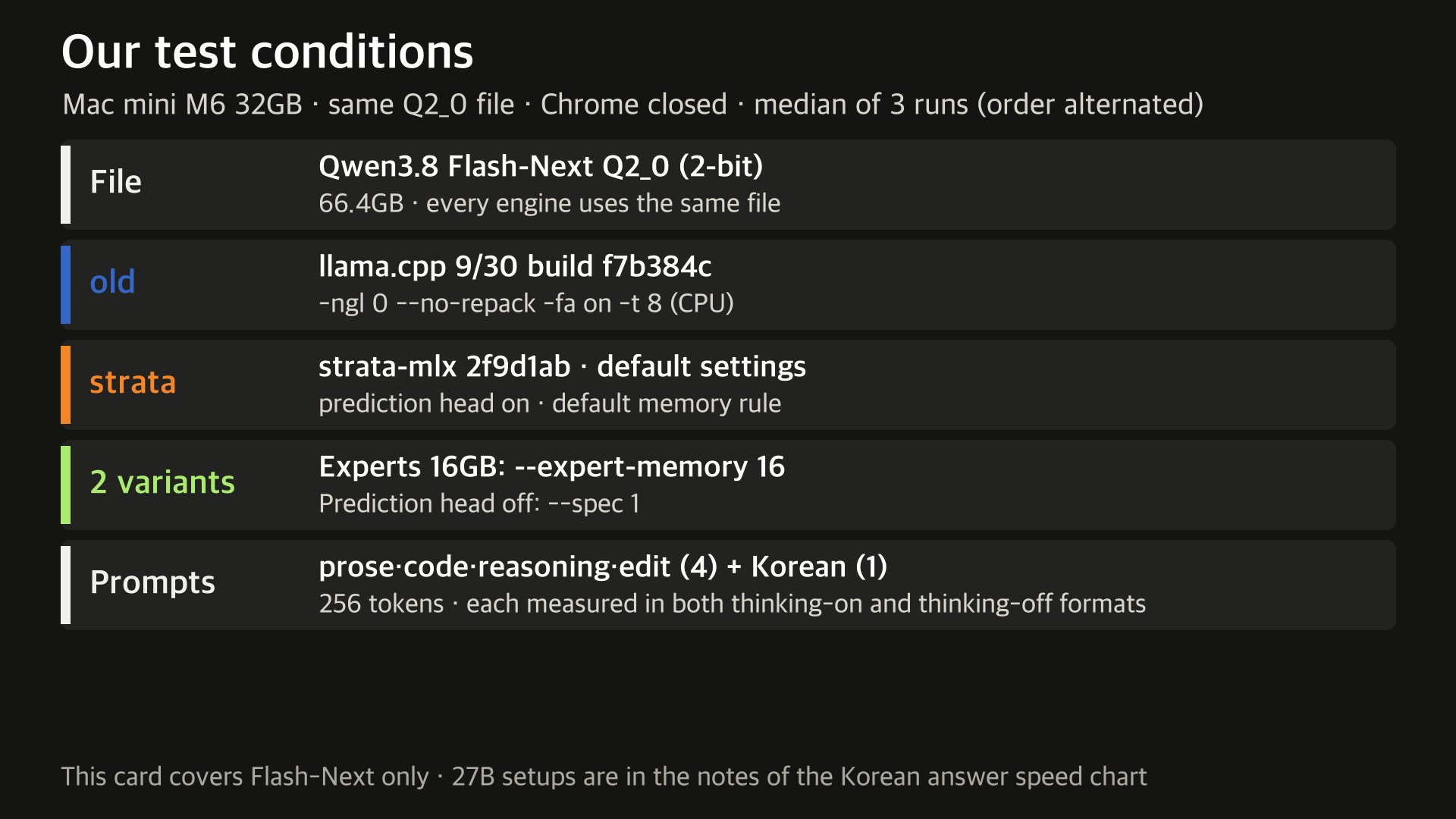
With the same file, the same questions and 256 generated tokens, we measured 5 question types (writing · code · reasoning · editing · Korean) 3 times each and used the median. We split the question format in two. The thinking-on format is the same method as the developer's documentation, and the model often thinks in English first. The thinking-off format attaches an empty thinking block so the model answers directly in Korean. We compare only within the same format.
We do not mix other people's numbers into our table
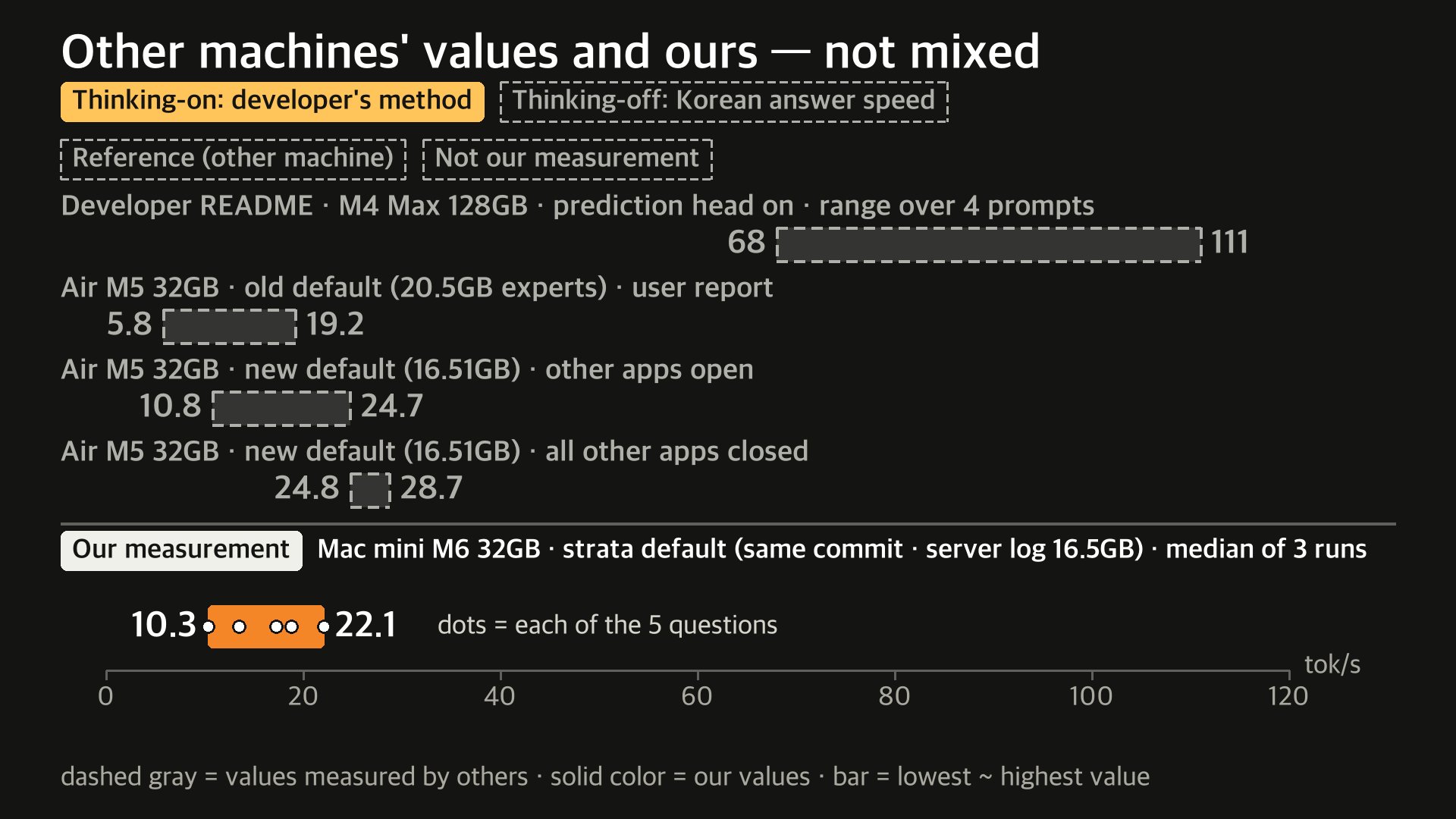
| Value | Tokens/s | Category |
|---|---|---|
| Developer's M4 Max 128GB, prediction head on | 68-111 | Cited (not our measurement) |
| MacBook Air M5 32GB user, new default, app open · closed | 10.8-24.7 · 24.8-28.7 | Cited |
| Our Mac mini M6 32GB, thinking-on format | 10.3-22.1 | Measured by us |
The machines and conditions differ, so we cannot tell why, and we do not use these for ranking. The 5.8-19.2 under the old default is a different setting from today's.
Speed: the same file, only the engine changed
In the thinking-on format, the older llama.cpp build (CPU) gets 7.1-7.9 tokens/s on all 5 questions. Strata default gets 10.3 for editing, 13.5 for Korean, 17.3 for code, 18.8 for writing and 22.1 for reasoning. In the thinking-off format, llama.cpp gets 7.2-7.8, and Strata default gets 17.2 for Korean, 17.5 for reasoning, 18.8 for code, 20.8 for editing and 24.0 for writing.
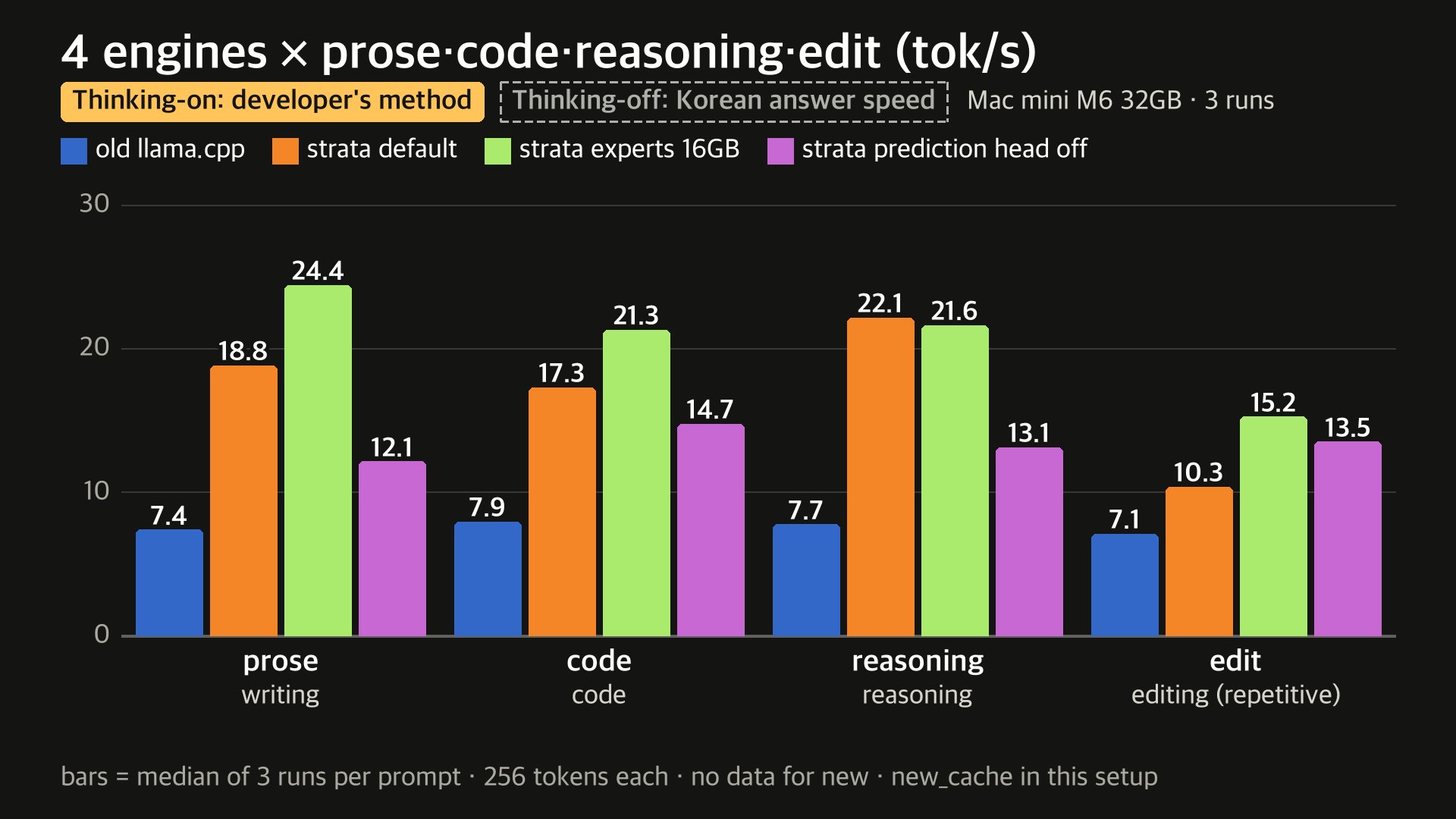
However, Strata default varied from run to run. Thinking-on writing ranged from 15.9 to 22.5 tokens/s. This data cannot separate whether swap, heat or run order was the cause.
Korean answer speed and the comparison with 27B
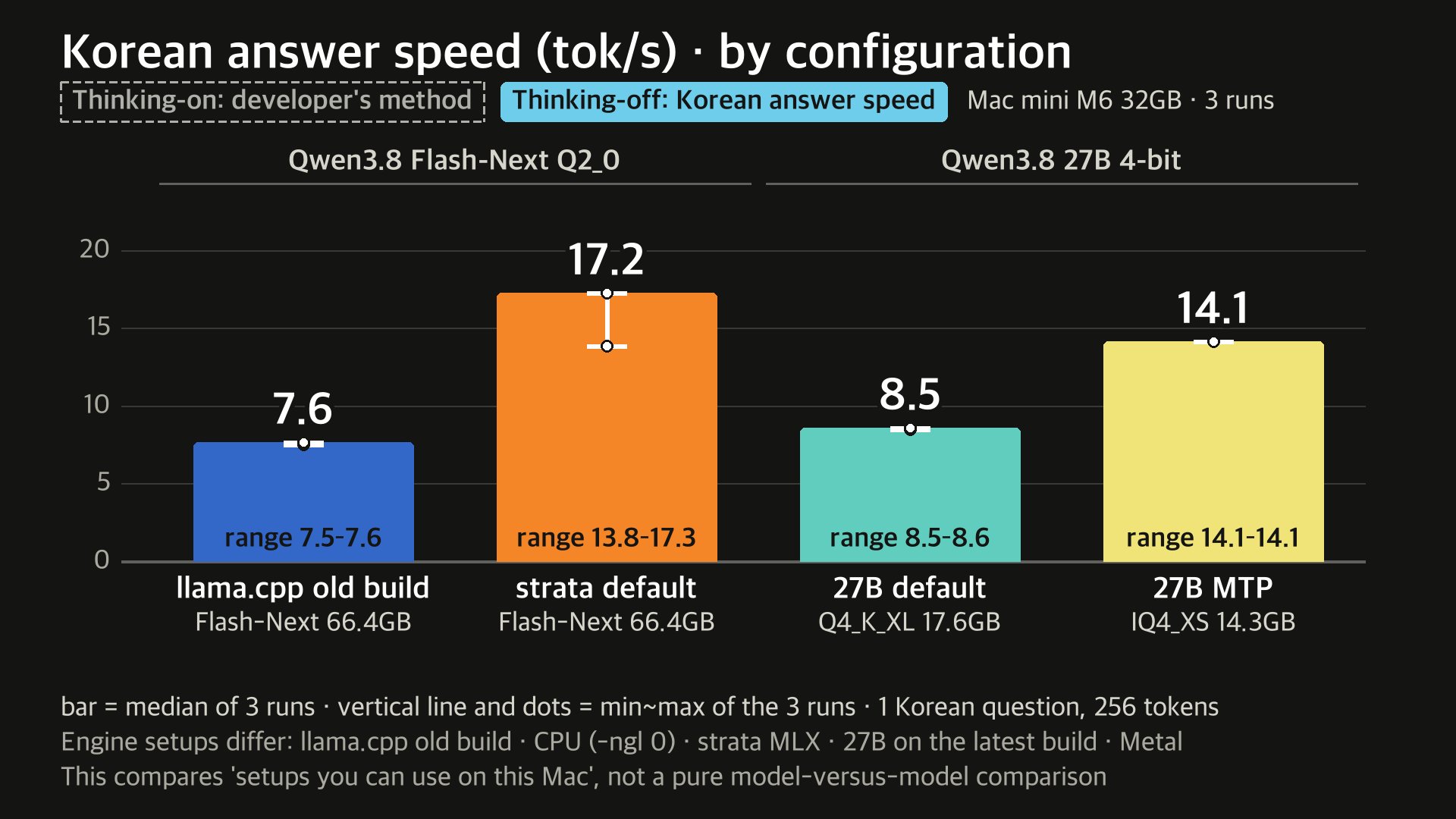
The 27B 4-bit runs on the latest llama.cpp (Metal) and Flash-Next on an older build (CPU), so this is not model against model but a comparison of "configurations you can actually use on this Mac." It is the thinking-off format with a Korean question (measured by us).
| Configuration | File | Tokens/s | Peak swap | Lowest free memory |
|---|---|---|---|---|
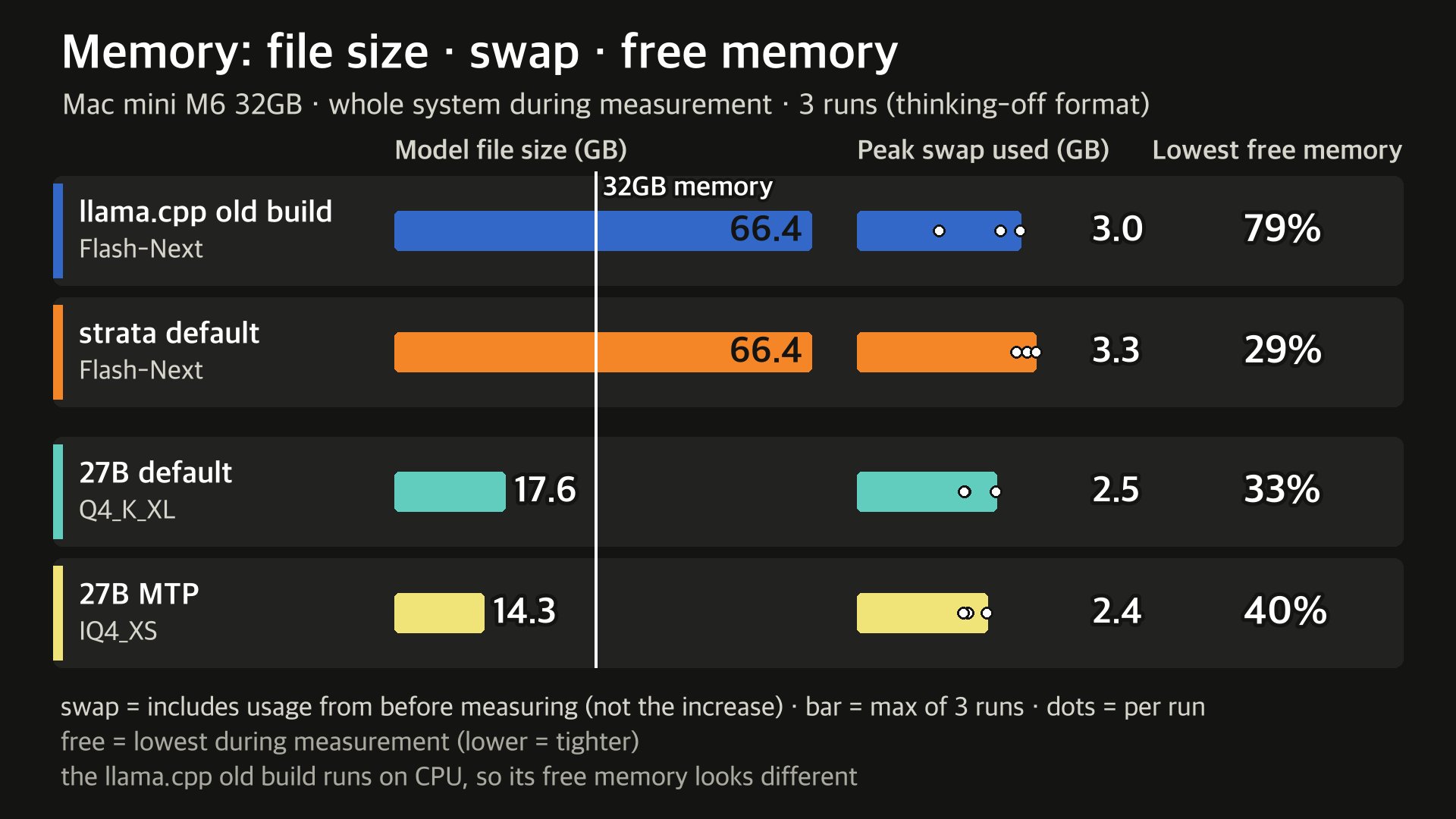
| Flash-Next llama.cpp | 66.4GB | 7.6 | About 3.0GB | 79% |
| Flash-Next Strata default | 66.4GB | 17.2 | 3.3GB | 29% |
| 27B default Q4_K_XL | 17.6GB | 8.5 | 2.5GB | 33% |
| 27B MTP UD-IQ4_XS | 14.3GB | 14.1 | 2.4GB | 40% |
Strata default's Korean runs were 13.8 · 17.2 · 17.3 tokens/s (median 17.2), and the minimum of 13.8 is lower than the 27B MTP's 14.1, so all we can say is "similar or slightly faster." Swap includes what was used before measuring, so we do not claim it is the cause of the speed.
Accuracy, coding and Chinese characters: the price of 2-bit
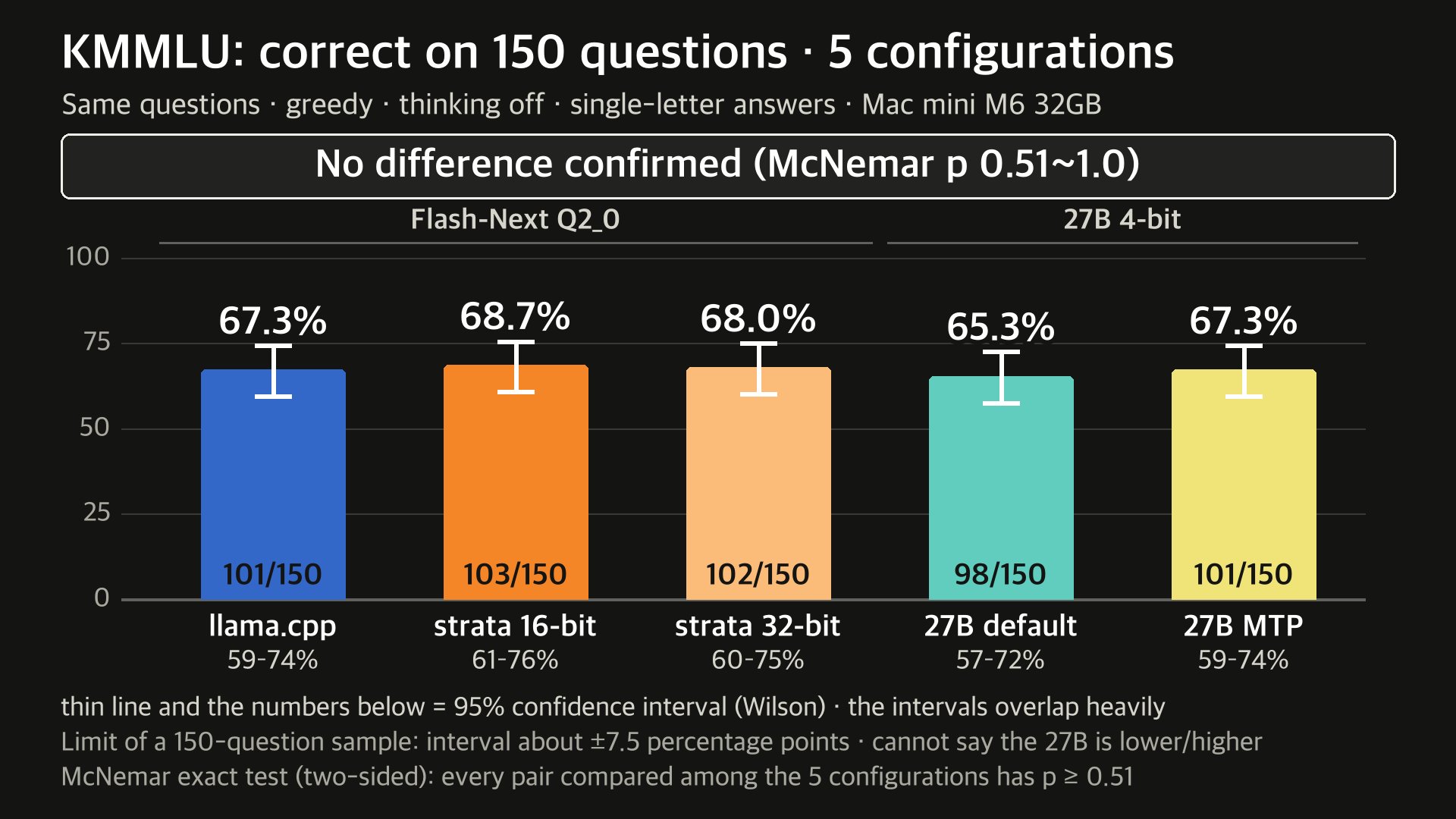
On 150 Korean multiple-choice questions (KMMLU), the correct answers were llama.cpp 101 · Strata fp16 103 · fp32 102 · 27B default 98 · 27B MTP 101, and a statistical test did not confirm a difference. With 150 questions the interval is about ±7.5 percentage points wide, so small differences are invisible.
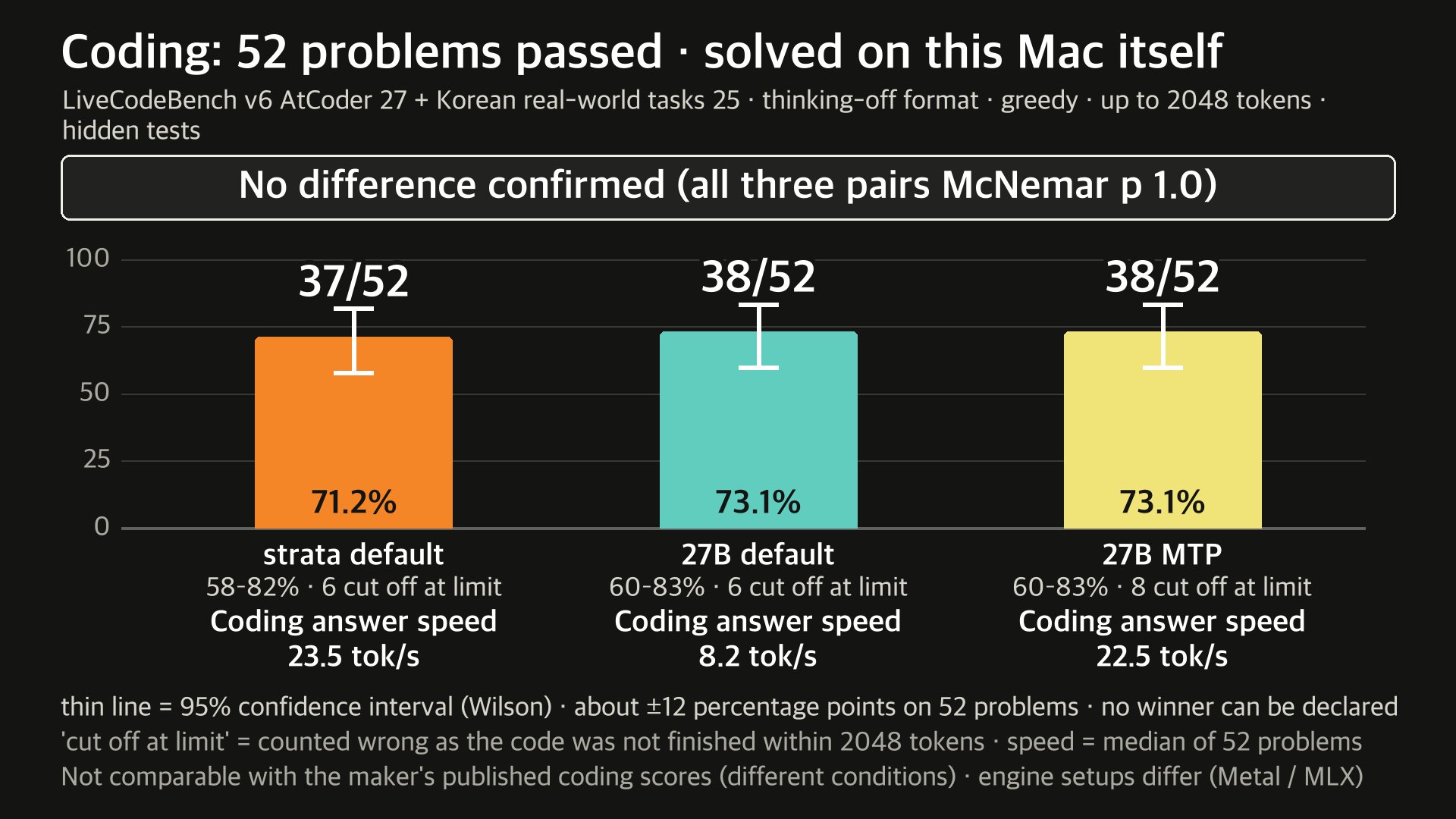
For coding we graded 52 problems in total, 27 from LiveCodeBench v6 and 25 Korean real-world tasks, with hidden tests (thinking-off format, up to 2,048 tokens).
| Configuration | Passed | Median coding answer speed |
|---|---|---|
| Strata default | 37/52 (71.2%) | 23.5 tokens/s |
| 27B default | 38/52 (73.1%) | 8.2 tokens/s |
| 27B MTP | 38/52 (73.1%) | 22.5 tokens/s |
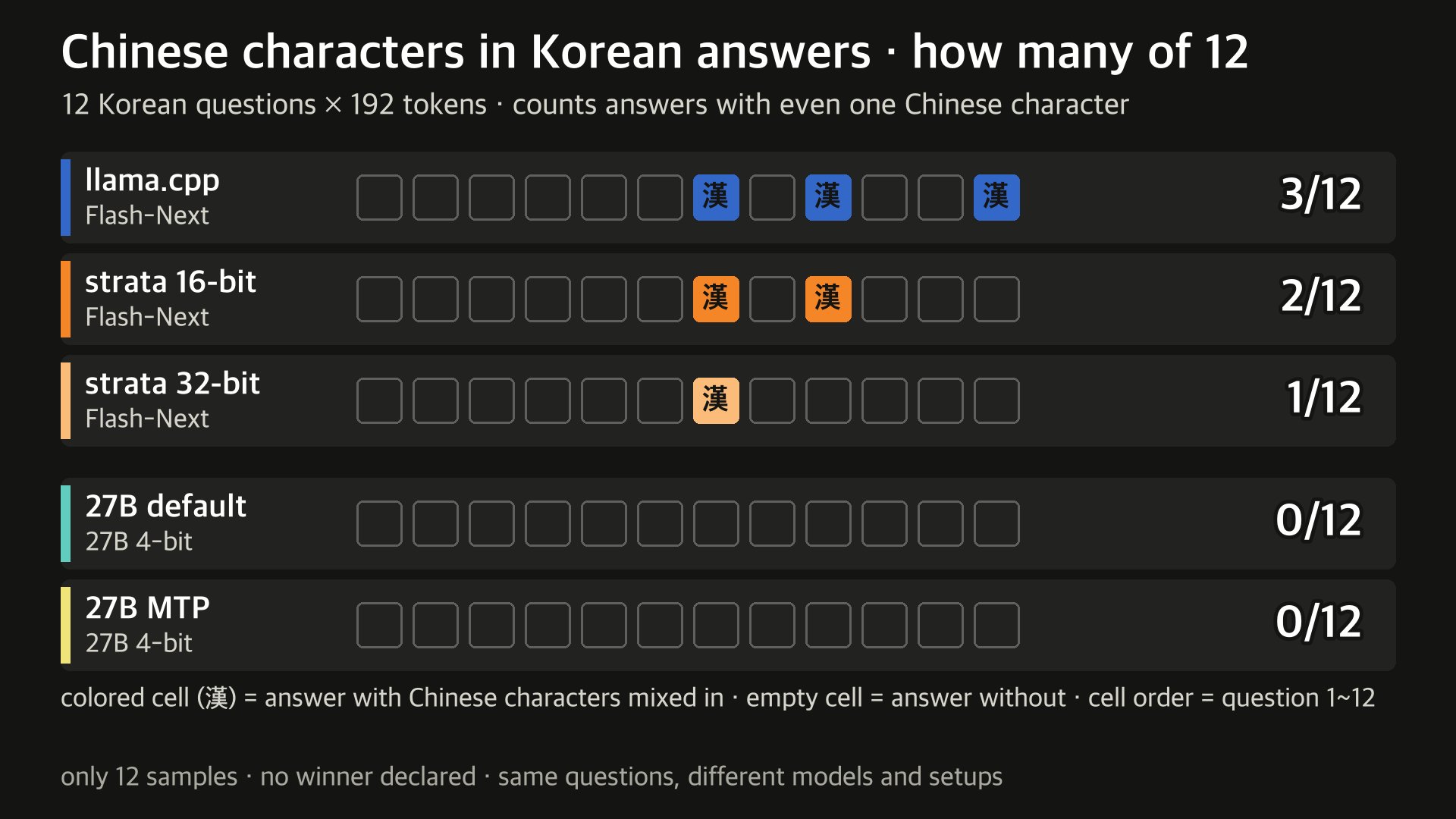
We could not confirm a difference in any of the three pairs (McNemar p=1.0). Among 12 Korean questions, answers with Chinese characters mixed in numbered 1 to 3 for Flash-Next and 0 for the 27B, but with only 12 samples, treat that as a reference only.
On the official model card scores (reported by the maker, at original precision), Flash-Next is higher: DeepSWE 58.7 vs 42.2, SWE-bench Pro 62.5 vs 61.7, and LiveCodeBench v6 91.9 vs 90.3. But the Q2_0 file is a reduced version, and in the file author's English measurement, LiveCodeBench fell from 87.43 to 81.14 (cited). We have no value for the coding scores of the two files measured under the same conditions.
How to choose
- If you put file size, free memory and Korean answers without Chinese characters first, the 27B is the one.
- If you put the official scores first and accept the cost of a 66GB file, choose Flash-Next.
- On speed, the 27B MTP and Strata default are similar, and this measurement gives no basis for choosing by coding accuracy.
Limits and sources
This is one Mac mini on one day, with 3 runs for speed, 150 questions for accuracy, and 52 coding problems as samples. strata-mlx is an unofficial engine, and it is specific to this model.
Sources and reference date. Measured 2026-10-13. The strata-mlx repository and issue 6, and the official model cards (Qwen/Qwen3.8-Flash-Next, Qwen3.8-27B).
This article is based on a video narrated with an AI voice, and AI assisted the writing. It is for information only and is not a purchase recommendation.